Showing posts with label March 2010 Podcasts. Show all posts

Thursday, January 20, 2011

Ankor Sabat

Short Story by C. Deskin Rink

This is Rink's first published story, and a PseudoPod Original. By my count, two more stories have since been published, both horror. This one is technically a Cthulhu mythos story centered on Tsathoggua, and in the style of his creator: Clark Ashton Smith. But honestly the only Tsathoggua we get is by way of a high priest and what a particular cyclopean temple was built in honor of. So you could sub in any dark god you want, really.

I saw a lot of hate for this story over on the PseudoPod forums, but I quite liked it. It was a bit slow getting started, and a tad confusing at first, but once we have our hero on his quest, it moves along pretty well. The meat of the story is Lord Galen's attempt to rescue his TrueLove™ from the evil priest, and to play the game the priest challenges him to. And this is absolutely the best thing about this story.

Although I've seen some criticizing this as generic horrific heroic fantasy, I beg to differ. There is an actual point, with themes and all that, rather than just some sap running off and having terrifying but meaningless adventures before dying or whatever the standard is. My favorite bit of resonance, is how we tend to put our loved ones "up on a pedestal" and imagine they are perfect. This story addresses that in two ways: both the tendency to remember the past fondly and forget all negatives of past romances, and in the present tense, to put a love up on a pedestal where they could never achieve that level of perfection if you were to look at them with unbiased eyes. Either way we can be sorely disappointed if we examine our past or present loves too closely while remembering only our ideal image, not what attracted us in the first place.

That said, although I liked the story at heart, want to defend it from attackers, and will certainly be looking out for more stories from Rink, I know I'm looking at my idealized version that ended about two minutes earlier. When I take this story down off the pedestal and inspect her, I remember that the end completely ruined it for me. A nice, thoughtful ending was all set up, and then we had to flash back to a long speech explaining everything to the point where it not only feels disrespectful to the intelligence of the reader, but actively detracts from the thematic internal dialogue I was having. It isn't just a case of Bondvillianitis, but the author going in to pound one last nail into the poor horse's coffin, missing, and smashing a hammer right through the rather pretty looking box. The story is shallower, and oddly less sinister, for the sinister, explanatory ending. (To be fair, Lovecraft and pals were often guilty of this, so it nailed the writing style...)

2.5 out of 5 of my carnal and gastronomical desires have been satisfied by this story.

Wednesday, January 19, 2011

The Mermaids’ Tea Party

Novelette by Samantha Henderson.
Read for PodCastle by Tina Connolly
Originally in Helix, free online

Cassandra is a little girl, the only survivor of a shipwreck. Rescued by sinister, bored mermaids who put her on an island with a pirate, at their mercy for food. She doesn't know whether she can trust the pirate, but she is absolutely sure she can't trust the mermaids. They want her to help them throw a tea party. And if they get bored, they're likely to kill her.

A coming-of-age story about a girl disappointed in the lack of fantastic creatures, who gets something much less Disney than what she might she might have hoped. Also the story of how rich men can be terrible people, and pirates might not be so bad. The ending is semi-ambiguous, but it is pretty clear what Cassandra is going to do. It's a straightforward story, unsurprising once you get the setting and all the pieces into place, but still suspenseful.

The writing and narration are excellent, the characters well-drawn, particularly Jack the Pirate, who has been stranded too long, gone a bit crazy, and only barely hanging on to his morality, but nonetheless hanging on, despite stress and loneliness, where other men (like Cassandra's father) are likely to fail. And Connolly's reading is great, particularly the accents. It lends the right tone to the darker scenes that really build the characters and the tense humor of the tea party itself, my favorite scene involving mermaids that I've ever read.
3.5 fishy bitches out of 5.

Smokestacks Like the Arms of Gods

Short Story by Ben Burgis
PodCastle's First Ever Original Story! Read by Ben Phillips

In a fantasy world where one big corporation owns everything, maintains an army, fights wars against goblins, and keeps its Irish-American-named workers from revolting by employing vampire security guards, a few steel workers organize a labor union.

Ben Philips does another great job of narrating in this one, and it somehow avoids the feeling of being too obviously just real life with generic fantasy elements added to it. Which was the most obnoxious thing about Narrative of a Beast's Life. While this is just labor unions with magic and vampires and goblins, the world building leaves a bit more unsaid, and by implication gives a grander scale to things.

The steel workers are taken seriously enough that the whole thing doesn't come off as hackneyed as it might have had the vampires been used for parody. This is a serious tale, not a Pratchett or Pratt wannabe. Which is good, because I frankly don't think Burgis could compete in that arena. My main criticism is that the whole thing was a bit obvious, and particularly, while I liked the very ending, it was easy to see coming as soon you knew what was going to happen to the guys. It was a great, but obvious, ending to a good, but obvious, story. The best part of the story was probably the goblin war, but that was all tangential to the tale being told, and was rightly kept to a minimum.

Still a good story with some nice imagery to live up to the title, and a great ending. 3.5 out of 5 steel factory foremen have green blood running through their veins.

Wednesday, September 15, 2010

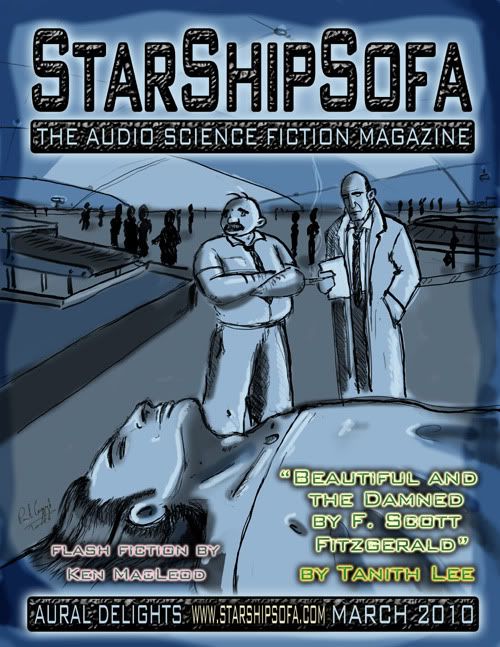
Starship Sofa March 2010


Episode #123: C.M. Kornbluth vs. Mercurio Rivera
Guest Editorial by Jason Sanford: A Change
How the Nebula ballot has improved with the recent change of rules, change is good, vote Starship Sofa!
Explained in 60 Seconds with Megan Argo
Black holes, gravity, and escape velocities. Still nothing we don't all already know. Even simpler than the last one.
Intro to Snatch Me Another by Mercurio Rivera
Publishing history, Associate Editor at Sybil's Garage Magazine, his writing group, and how the story was an expansion of his earlier Dear Annabehls from Electric Velocipede #17/18.
Fiction: Snatch Me Another by Mercurio Rivera 4.5/5
Looking Back at SF History with Amy H. Sturgis
Margaret Cavendish, Duchess of Newcastle-upon-Tyne, 1623-1673, poet, natural philosopher, and correspondent with many members of the Royal Society. She wrote poetry about astronomy, long before it was cool, some of the better examples are read by Amy here. She also wrote a very early science fiction novel, with bear-people on another planet, criticism of chauvinism, and a level of metafiction you don't expect to see until much later. I'm inclined to read both the novel, and a bunch of this poetry some day, and many thanks to Amy H. Sturgis. Rating: A+
Intro to The Adventurer by Lawrence Santoro
Larry reminisces about reading Kornbluth as a kid, particularly his humor and plotting and overall skill. Discusses his tragic early death. Larry says Kornbluth>Asimov>Heinlein>Everybody Else at the time.
Fiction: The Adventurer by C.M. Kornbluth (Classic) 4/5

Episode #124: Will McIntosh
Guest Editorial by Mur Lafferty: Fanzines
Mur makes fun of and points out the irony of science fiction fans and writers being opposed to new technology and internet fiction sources winning awards. She just reads her blog post linked above, but her voice emphasizes her humor and righteous anger. Worthwhile.
Interogation: Gene Wolfe
Wolfe gives a great interview and can talk forever with very little prompting. He talks about his desire to bury other SF writers in his basement, replace them, and claim their work, and about how now that he has been writing for a long time, he is now capable of sitting down and writing about bees if someone is writing a bee-themed anthology. Wolfe addresses how writing works, his process, and learning Ancient Greek. Everything he says seems to be both well-thought-out and humorous. I could listen to Gene Wolfe for hours, and, although I haven't yet, I'd consider donating to Starship Sofa just for the extended interviews for a few more like Wolfe. Rating: A
Fiction: Bridesicle by Will McIntosh 4/5
Observation Deck with Cheryl Morgan
Cheryl Morgan reports from the Library Bar at P-Con (Phoenix Convention). Nick Harkaway is the guest of honor. A summary of what conventions she was on and what sort of breakfast the hotel served. Definitely not worth the 15 minutes. Rating: F

Episode #125: James Morrow
Editorial by Tony C. Smith: Thank You
Science News with J.J. Campanella
Promo: Galactic Suburbia
Fiction: Lady Witherspoon's Solution by James Morrow

Episode #126: Karen Joy Fowler
Editorial by Tony C. Smith: The Interviews
Film Talk with Rod Barnett
Fiction: Always by Karen Joy Fowler

Episode #127: Tanith Lee
Editorial by Tony C. Smith: What Happened to Me This Week
Flash Fiction: iThink by Ken MacLeod
StarshipSofa Stories Vol. 2 Update by Dee Cunniffe
Fiction: The Beautiful and the Damned by F. Scott Fitzgerald by Tanith Lee

Tuesday, September 14, 2010

The Beautiful and the Damned by F. Scott Fitzgerald


by Tanith Lee
Read for Starship Sofa by J.J. Campanella

iThink

Flash Fiction by Ken MacLeod
Read for Starship Sofa by Geoff Michelli

Always

by Karen Joy Fowler
Read for Starship Sofa by Amy H. Sturgis

Lady Witherspoon's Solution

by James Morrow
Read for Starship Sofa by Peter Seaton-Clarke & Nicola Seaton Clarke

The Adventurer

Short Story by C.M. Kornbluth
Free from Project Gutenberg
Read for Starship Sofa by Lawrence Santoro

I wasn't quite as impressed with this story as I felt I should have been. It may be the reek of the 50s, but I find it in my heart to love Asimov and Bradbury, you'd think I would love Kornbluth more. The concept is good and there is a nice layer of satire in the story:

America is a few hundred years into the future, still engaged in a cold war with the Soviet Union. The people are stupid and disinterested, and, more importantly, the president is stupid and disinterested and has become a hereditary position with all the name-only trappings of democracy you'd expect from us. It's really a dictatorship where cabinet members get executed as traitors on a whim, everyone spies on everyone else, and the people are kept in line through a mix of mind-control, terrorism, random executions, and press censorship.

Like some of Bradbury's work, Kornbluth is hating on anti-intellectualism before it was common, although it isn't the center of this story as it is in some of his others. Basically, the cabinet members want to overthrow their idiot-king but are certain they'll fail if they try any of the traditional means. Meanwhile, we read about the seemingly unrelated life of a young cadet.

The last lines are actually very surprising. I'd foreseen the main development, as I'm sure most readers will, but not only are some of the root causes different than we'd have thought, but the ultimate future of the nation doesn't go where I was expecting either. Kornbluth sets us up for one thing, especially given the hopefulness of the era, and then gives us a rather sobering, but probably more likely conclusion. And, again, it was all there earlier in the descriptions and the explanation of the title. I'll be left thinking about the stealth-moral of this story for years, I think. What is the true difference between the conquering hero and the villain?

Still, there is something about Kornbluth's prose that doesn't really strike me here, although Larry's narration is great as always, and this story, at least, isn't quite brilliant or subtle enough to be a favorite. 3.5 Soviet Jovian moons out of 5.

First Published in Space Science Fiction, May 1953

Snatch Me Another

Short Story by Mercurio Rivera
Published free online in Abyss & Apex #25, 2008
Read for Starship Sofa by Liz Mierzejewski

A very dark tale of two parents mourning the loss of a child. One turns to drugs and despair and withdraws from everything, the other goes fairly crazy, and remains happy. Both of these reactions play out to tragic extremes by the end. To complicate matters, this takes place in a near future where we've developed the technology to bring things over from other universes.

Both main characters are well characterized and empathetic in their madness. It's easy to imagine either reaction being your own, although you'd hope to be stronger, or at least more stable. There is a spinning, terrifying, sickening, vertigo feel to some of the description that's much more effective than the bland description so common in stories with this sort of technology. It seems perfectly real, but horribly so. Everything from the clouds to the minister to the drug inhalers at the beginning foreshadows the end and builds on some of the themes.

That said, I'm glad I went back and read this as text. The audio didn't work for me nearly as well here. I might not have given it a second chance if it weren't for the impression of brilliance behind the narration.

I have to say I'm not a fan of Mierzejewski's voice. She does do different voices for the characters, but the two main ones run together at times, I don't really like her voice in the narration, and there is something in her cadence that just sort of bothers me. The speed changes make things a little harder to follow than they could be. She does capture a lot more emotion toward the end though, but there's a singsong quality to the beginning that feels out of place in such a dark tale. It's so rare to be disappointed in a Starship Sofa narration that I'm still a bit surprised.

So, not something for a light mood, but dark and thoughtful and terrible, in the best possible way. Snatch me another story from Mercurio Rivera. 4.5 out of 5.

Sunday, January 24, 2010

Bridesicle

Short Story by Will McIntosh
Published in Asimov's
Later Podcast by Starship Sofa, read by Amy H. Sturgis

What happens when we have the technology to wake up all the cryogenically frozen people? Fixing whatever killed them is sure to be expensive, so who'd really want to waste the money? Lonely/creepy old men of course!

Mira wakes up after her car crash, confused and disoriented, in a "dating center". She finds out that the only way to get revived is to convince a random man to marry her. Except she is a lesbian. As one of the older people stored in the dating center, she doesn't get many visitors wanting to wake her up for a date, hundreds of years pass between prospective husbands. Eventually she finds out her true love is frozen in the same facility. The question remains, is death somehow better than loveless marriage? Probably not. Takes the whole "I'd rather be dead than sleep with you" comment to a new level of seriousness.

Anyway, the story has a much nicer ending than the downer I'd probably have wrote, but it is still a good one. There is a small subplot about just what happened in the accident, and I found the whole marriage-for-revival situation to be suitably horrifying-yet-plausible. Well done. Just one question: WHY ARE THERE NO LESBIANS IN THE FUTURE? Seriously, this isn't even remarked on, everyone takes the whole bridesicle trade as male exclusive without a second thought. Our protagonist is a lesbian, but when she brings it up, everyone is doubleplus shocked. And nobody ever thought to ask.

Despite the conspicuous, unexplained absence of homosexuality in a future liberal enough to allow fluorescent orange-skinned lawyers, I'd give this horrifying future/bittersweet love story a 4 out of 5.