Showing posts with label Wrap-Up. Show all posts

Wednesday, August 31, 2011

Analog July/August 2011

An issue pretty much carried by Richard Lovett

Serial:
Energized, Part II of IV by Edward M. Lerner: NOT REVIEWED

Novella:
Coordinated Attacks by Kristine Kathryn Rusch: 2.5

Novelettes:
Jak and the Beanstalk by Richard A. Lovett: 4
One Out of Many by Kyle Kirkland: 2.5

Short Stories:
Probability Zero: ... Plus C'est La Meme Chose by Arlan Andrews, Sr.: 3.5
A Witness to All That Was by Scott William Carter: 1.5

Articles:
So Long, Proxima Centauri by Kevin Walsh: B

Schmidt's editorial is a decent enough read, and The Alternative View is better than it often is, but the reviews in this issue are absolutely awful. Painful to read as well as useless.

One stand-out story in Lovett's "Jak and the Beanstalk", one stand-out article in Lovett's "Narrative Voice". The articles are mostly better than the stories, being 3/4 enjoyable, although aside from "A Witness to All That Was", the lesser of the fiction is never really bad. A lot of it is unimpressive, but only one story really bothers me.

Not a great issue of Analog, but not without its merits either.

Monday, February 28, 2011

Asimov's January 2011

Short Pieces markedly better than long ones.
Novella:
Killer Advice by Kristine Kathryn Rusch: 2

Novelette:
Two Thieves by Chris Beckett: 1.5

Short Stories:
Interloper by Ian McHugh: 3.5
Ashes on the Water by Gwendolyn Clare: 3.5
Dolly by Elizabeth Bear: 3
Visitors by Steve Rasnic Tem: 2

And two poems, rising as high as "meh"+ and sinking as low as "meh"-.

Ian McHugh's "Interloper" is far and away the standout story of the issue. I didn't blow me away, but it was the most exciting, most interesting, and probably second most thoughtful.

"Ashes on the Water" by Gwendolyn Clare was a very short, heartwarming tale of mourning in water-scarcity future India.

Elizabeth Bear's "Dolly" is the only other story I enjoyed, being an Asimov Detectives-And-Robots homage. It's funny and philosophical, but ultimately feels too familiar. Still, this is probably the most thought provoking story, and while I didn't love it, it is still worth reading.

I actively disliked all the other stories, which were much longer, making this issue a waste in terms of pagecount. Read the three short stories in the bookstore, or from a subscribing friend, or when they get anthologized later.

Friday, December 10, 2010

Science News with J.J. Campanella 2010

A summary of J.J. Campanella's Science News articles in Starship Sofa for the year 2010.

#114, 12/23/09, Rating: A: Contagious Emotions, Caterpillar-Ant Trickery, Tumor Suppressors, Ebay Shrimp Naming, Marijuana as Addiction Cure.

#118, 1/26/10, Rating: A: Tasmanian Devil Facial Tumor Disease, Sea Urchin Sight, Environmental Causes of Lupus Evidence, Whiskey Hangovers.

#122, 2/23/10, Rating: B: Dinosaur Coloring, Sea Slug Photosynthesis, Cigarette Bacteria, Prion Function.

#125, 3/17/10, Rating: K:

Looking Back at Genre History with Amy H. Sturgis 2010

A summary of Amy H. Sturgis' Genre History articles in Starship Sofa for the year 2010.

#112, 12/9/09, Rating: C: Captain Nemo, 20,000 Leagues, and The Mysterious Island.
#115, 1/5/10, Rating: B: Anthony Trollope and a discussion of his 1882 novel The Fixed Period.
#120, 2/9/10, Rating: A: Ishmael, an unusual 1985 Star Trek novel by Barbara Hambly.
#123, 3/3/10, Rating: A+: Margaret Cavendish, 17th century poet, scientist, and SF writer.

Film Talk with Rod Barnett 2010

A summary of Rod Barnett's Film Talk articles in Starship Sofa for the year 2010.

#113, 12/15/09, Rating: A: Negative review of The Box, discussion of Richard Kelly's other films.
#116, 1/12/10, Rating: B: Semi-positive review of Avatar.
#122, 2/23/10, Rating: B: Daybreakers and Book of Eli, both somewhat positively reviewed.
#126, 3/23/10, Rating: K:

Explained in 60 Seconds with Megan Argo 2010

A summary of Megan Argo's Explained in 60 Seconds pieces for Starship Sofa in the year 2010.

#118, 1/26/10, Rating: C: Red Dwarf Stars.
#123, 3/3/10, Rating: D: Black Holes and Escape Velocity.

Thursday, December 2, 2010

Starship Sofa February 2010


Episode #119: Old School vs. New School
Editorial: Some new ideas for the podcast; interview style: interrogation
SF News from Tony: Kage Baker's Death, Sir Terry Pratchett's assisted suicide test case.
Interrogation of Lucius Shepard
I don't like this interview format at all. I love Lucius Shepard as a writer, and his answers aren't bad or particularly dull, but Tony doesn't engage with him on topics like going to Somalia or his abusive father, just moves on to the next pre-determined, and rather dull, question. Rating: D
Knotwork by Nina Kiriki Hoffman (New School) 4/5

Episode #120: Gene Wolfe
Editorial: Tony gives a sweet, Valentine's Day tribute to his wife.
SF News: Independent book publishers and movement to DRM-free books from Night Shade, Neil Gaiman to write Doctor Who episode(!!!!), death of William Tenn
Promo: Beware The Hairy Mango - Matthew Sanborn Smith's hilarious podcast
Looking Back at SF (and Western) History by Amy H. Sturgis
Ishmael by Barbara Hambly (1985) is regarded as one of the best of the early Star Trek novels, and also one of the weirdest. Most of the action takes place in the alternate history Seattle of the 1968-1970 TV series Here Come the Brides, itself an unusual Western inspired by the story of the Mercer Girls. This bizarre cross-over novel also cameos Han Solo, the Second and Fourth Doctors, Starbuck and Apollo, Emperor Norton, Paladin, and characters from Gunsmoke, Rawhide, and Bonanza, among others. Here Come the Brides, and Star Trek aired around the same time, and Hambly explains in this book why Sarek and Aaron Stempel (both played by Mark Lenard) look alike. So there is an amazing amount of crossoverness and complexity, and apparently the whole thing is semi-canon. I'm very glad to have Sturgis not only pointing out this book, but explaining all the complexity and references in it, and a brief look at how it paved the way for novels such as Shatnerquake! Rating: A
Pulp Cover by Gene Wolfe 4/5

Episode #121: Paolo Bacigalupi
Guest Editorial by Amy H. Sturgis: Hugos and Podcasts
A history of the Hugo awards and electronic and audio media eligibility.
The Gambler by Paolo Bacigalupi 4.5/5
A Hugo for Starship Sofa by Matt Sanborn Smith:
An argument for why you ought to vote for Starship Sofa for Best Fanzine in the Hugos, basically transcribed on his blog. It worked!

Episode #122: Massive 3-hour Michael F. Flynn Episode
Guest Editorial by Lawrence Santoro: The Hugo's
Long-winded audio expansion of the linked blog post. Santoro talks about his geeky 3rd grade teacher who got him interested in SF, the Futurians, and the feeling of community surrounding Starship Sofa. He rambles on a bit, but it's interesting and certainly a worthwhile editorial, more interesting but less persuasive than Matt Sanborn Smith's argument last issue. On one hand, 18 minutes is too long, on the other hand, it doesn't seem like 18 minutes.
The Transcribe Project by Will Reese
Tony interviews Will Reese of the Transcribe Project in a pub in England. Will is amusing in his tales of procrastination (and the number of drinks he orders), but, again, not really entertaining or informative enough to justify 17 minutes listening time.
Science News by J.J. Campanella
An amusing introduction about Jim's children and their obsession with Dinosaur Train leads into a neat article about melanosomes being recovered from fossils which indicate dinosaurs likely had patches and stripes in white, black, red, brown, yellow and orange and may have been closer to birds in their coloring rather than lizards. It turns out the reason scientists often color dinosaurs in drab colors is that they had no evidence and didn't want to make any embarrassing assumptions, so they chose drab lizard colors.
Next up is an AWESOME article about sea slugs who have been able to steal chloroplasts from algae and keep the chloroplasts alive inside their own cells. These sea slugs are now able to create their own chlorophyll and have working photosynthesis, the first animal we've found to do so.
Another new paper suggests that bacteria on cigarettes, specifically in the tobacco itself, can actual survive in smoke to cause lung infections when inhaled. Hundreds of species of bacteria, many potentially infectious in humans, have been identified in a testing of common cigarette brands.
Finally, in a Kuru study, evidence has suggested a new potential function for the protein that mutates into the infectious prions causing it. This protein may be involved in signaling Schwann cells to produce myelin, and if it is, it could throw a wrench in some types of Mad Cow Disease research.
Nothing boring here, and the sea slug piece was great, but at only 3 minutes out of a 19 minute segment, with too much time spent on prion semi-news and dinosaurs, I just don't think this was as good as some of Campanella's other editions. Rating: B
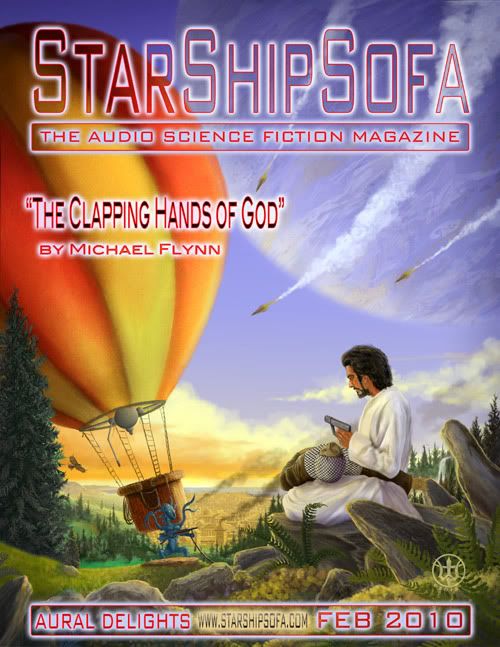
The Clapping Hands Of God by Michael F. Flynn 4/5
Film Talk by Rod Barnett - Daybreakers & The Book of Eli
Commentary on the fact that interesting films are often released in Jan/Feb because studios don't want to release anything that makes money then, and by that they mean big budget crap.
Daybreakers is a post-apocalyptic science fiction vampire film with an excellent cast, and decent effects considering its low budget. Although it isn't a great movie or a classic or anything, Barnett gives it a reservedly positive review because it doesn't romanticize vampires, has a touch of humor, and addresses issues like over-population and depletion of resources. Despite reading a few negative reviews elsewhere, I'm inclined to see this one just for the novelty.
The Book of Eli is about a post-apocalyptic wanderer protecting one of the last copies of The Bible after most copies were burned following whatever wiped out civilization. Barnett likes the treatment of religion and faith in what might have otherwise been a standard action movie.
We're a little light on substance this time, but I'm glad he brought Daybreakers to my attention, and it's interesting to hear about the ideas involved there. The Book of Eli review was pretty slim though. Rating: B

Wednesday, November 24, 2010

Asimov's December 2010


A generally mediocre-but-not-bad issue of Asimov's Science Fiction.

Novelettes:

Short Stories:
There are also 3 poems, nothing special but not too bad overall.

There was nothing truly outstanding in this issue, but nothing truly bad either. Despite being clustered around the middle, it was quite easy to establish a hierarchy. Variations is just outright more powerful than Prize or Warfriends, and given that it is his first work, I think Werkheiser is worth looking out for in the future. I was waffling between 3.5 and 4 for him, while the others were more on the 3.5 vs. 3 end.

Likewise, Uncle E was strictly better than Sins of the Father. Both are simplistic stories, but Emshwiller writes more beautifully and captures the thinking of children, plus there is a bit more underlying subtlety there.

Russia and Excellence are both partially fumbled stories by well-established masters. It's funny that the three most famous writers in the issue all got scores of 2.5, I'm not trying to hold them to a higher standard, but I'll admit there is a subconscious possibility when I see things by such prolific writers. On the other hand, maybe they've all gotten a tad lazy. Regardless, my feeling is that the stories are well-written enough, but they have essential plot failings. But Excellence is a clear top because it is trying to make a less common and, I think, more significant point.

The pairs of stories by rating really do complement each other nicely. But I put Libertarian Russia at the bottom of the issue, and some people have loved it. I don't think it is actually bad, just not good enough to recommend. But I feel safe in saying that nothing in this issue is actually a waste of time if you do happen to be reading it.

As to the Departments:
Editorial: Sheila and Ted's Excellent Adventure has a most triumphant title, and while it has little substance, provides a nice bit of human-interest news about the SFWA gathering for the Space Shuttle Atlantis launch. The neat pictures are the kind of thing worth seeing, and justify the page count.

Reflections: Rereading Kornbluth provides a bit of history, and performs the valuable public service of increasing C.M. Kornbluth awareness.

On Books: Reviews The Bird of the River by Kage Baker, Kraken by China Mieville, Coyote Horizon and Coyote Destiny by Allen Steele and The Business of Science Fiction by Mike Resnick & Barry Malzberg.

It's somewhat annoying that all the reviews are positive buy-this-now endorsements, but given the caliber of the writers, it may be more than blowing smoke. Given the reviews, I definitely need to read Kraken, and while I suspect I can leave the others alone, the reviews provide enough interest that were I to see a few more positive reviews, I might give them a shot, although I suspect they aren't exactly my thing.

I am a bit disappointed in the reviews because they don't provide much depth beyond plot summary, and they are somewhat out of date, but nothing really wrong here.

I'd say that is the overwhelming theme of this issue: Nothing wrong, no big problems, but nothing really outstanding. Adequate.

Wednesday, September 15, 2010

Starship Sofa March 2010


Episode #123: C.M. Kornbluth vs. Mercurio Rivera
Guest Editorial by Jason Sanford: A Change
How the Nebula ballot has improved with the recent change of rules, change is good, vote Starship Sofa!
Explained in 60 Seconds with Megan Argo
Black holes, gravity, and escape velocities. Still nothing we don't all already know. Even simpler than the last one.
Intro to Snatch Me Another by Mercurio Rivera
Publishing history, Associate Editor at Sybil's Garage Magazine, his writing group, and how the story was an expansion of his earlier Dear Annabehls from Electric Velocipede #17/18.
Fiction: Snatch Me Another by Mercurio Rivera 4.5/5
Looking Back at SF History with Amy H. Sturgis
Margaret Cavendish, Duchess of Newcastle-upon-Tyne, 1623-1673, poet, natural philosopher, and correspondent with many members of the Royal Society. She wrote poetry about astronomy, long before it was cool, some of the better examples are read by Amy here. She also wrote a very early science fiction novel, with bear-people on another planet, criticism of chauvinism, and a level of metafiction you don't expect to see until much later. I'm inclined to read both the novel, and a bunch of this poetry some day, and many thanks to Amy H. Sturgis. Rating: A+
Intro to The Adventurer by Lawrence Santoro
Larry reminisces about reading Kornbluth as a kid, particularly his humor and plotting and overall skill. Discusses his tragic early death. Larry says Kornbluth>Asimov>Heinlein>Everybody Else at the time.
Fiction: The Adventurer by C.M. Kornbluth (Classic) 4/5

Episode #124: Will McIntosh
Guest Editorial by Mur Lafferty: Fanzines
Mur makes fun of and points out the irony of science fiction fans and writers being opposed to new technology and internet fiction sources winning awards. She just reads her blog post linked above, but her voice emphasizes her humor and righteous anger. Worthwhile.
Interogation: Gene Wolfe
Wolfe gives a great interview and can talk forever with very little prompting. He talks about his desire to bury other SF writers in his basement, replace them, and claim their work, and about how now that he has been writing for a long time, he is now capable of sitting down and writing about bees if someone is writing a bee-themed anthology. Wolfe addresses how writing works, his process, and learning Ancient Greek. Everything he says seems to be both well-thought-out and humorous. I could listen to Gene Wolfe for hours, and, although I haven't yet, I'd consider donating to Starship Sofa just for the extended interviews for a few more like Wolfe. Rating: A
Fiction: Bridesicle by Will McIntosh 4/5
Observation Deck with Cheryl Morgan
Cheryl Morgan reports from the Library Bar at P-Con (Phoenix Convention). Nick Harkaway is the guest of honor. A summary of what conventions she was on and what sort of breakfast the hotel served. Definitely not worth the 15 minutes. Rating: F

Episode #125: James Morrow
Editorial by Tony C. Smith: Thank You
Science News with J.J. Campanella
Promo: Galactic Suburbia
Fiction: Lady Witherspoon's Solution by James Morrow

Episode #126: Karen Joy Fowler
Editorial by Tony C. Smith: The Interviews
Film Talk with Rod Barnett
Fiction: Always by Karen Joy Fowler

Episode #127: Tanith Lee
Editorial by Tony C. Smith: What Happened to Me This Week
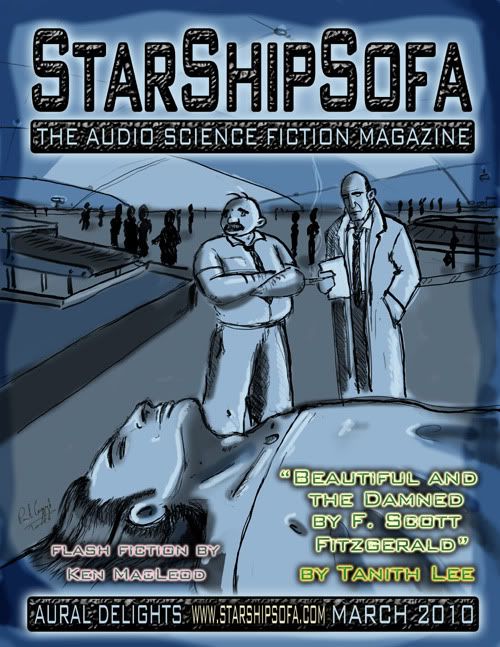
Flash Fiction: iThink by Ken MacLeod
StarshipSofa Stories Vol. 2 Update by Dee Cunniffe
Fiction: The Beautiful and the Damned by F. Scott Fitzgerald by Tanith Lee

Wednesday, May 19, 2010

2009 Nebula Award Nominees

Short Story:
I Remember the Future by Michael A. Burstein: SHUNNED

Novelette:

Novella:
The Women of Nell Gwynne's by Kage Baker: Impossible to get for under $100

All stories ranked in order of my preference. Winners in bold. In cases where two stories had the same score, I preferred the one higher on the list. But my general guideline is that I'd be happy with anything that scored 4 or higher winning a Nebula, and anything 3.5 or lower winning would be a disappointment. While I would vote for Sinner, Baker, Fabulist, Priest, I would be perfectly content with the awards process to see Divining Light win.

In particular, I hugely prefer Spar to Bridsicle in the short story category, just barely not enough for different ratings, I prefer The Gambler over Memory of Wind significantly, although Sinner, Baker, ... makes that decision moot, but God Engines and Shambling are very close in the Novella category. I have decided I prefer Scalzi in this case, but only by a hair, and on average I'm a bigger fan of James Morrow than John Scalzi.

Turns out I pretty much called them, with the exception of Novellas where I was unable to even read the winning story. I'd love to see the voting numbers for runners up placing and how close I was on the runners up.

Thursday, March 25, 2010

Podcasts: January 2010

Escape Pod (2.5)
On the Human Plan by Jay Lake: 2

PseudoPod (3.4)

Starship Sofa (3.8)

The Escape Artists podcasts didn't do so hot this month. Escape Pod wasn't even worth my time, the most memorable thing from it was the setting (which I liked) of my least favorite story: Protocols. Podcastle had my absolute favorite story with End of the Empire, but were more misses than hits. Still I keep coming back to them because every once in a while they publish the stories I love the most. Pseudopod was the most consistent, and even though I didn't like The Tamga, I don't feel cheated. Blessed Days and Turning the Apples are both still stories I can't shake, and while not the top of my list, being enjoyable and memorable is worth something. I think Pseudopod is the most consistently good of the three.

Overall, Clarkesworld had a very good month, and there is a reason they win awards. Starship Sofa was very consistent, with stories I really enjoyed, but never sinking below a high level "meh", unlike some of the other podcasts. The articles on the Sofa were off and on, but the good ones were worth it.

Overall Fiction Favorites:
1: The Things
2: Another End of the Empire
3: The Good Detective

Sunday, February 28, 2010

The Magazine of Fantasy & Science Fiction: January/February 2010


A very good issues of the magazine, well worth the money.
Short Stories:

Novelets:

Novella:

As far as fiction goes, even the comparative duds of this issues were better than many of the stories that get published elsewhere. I'm glad that the first issues of F&SF I reviewed here was a good one, it makes it easier to justify my unscientific favoritism.

Ghosts Doing the Orange Dance is easily my favorite of the issue, although Late Night Train, Songwood, and City of the Dog were also highlights. And despite it being lower rated, I appreciate Writers of the Future quite a bit. But I bought a second copy of this issue just so I could loan it out and make people read Ghosts.

As for the columns, no surprises here, these are my sort of standard opinions, but I figure I should state them for the 99.9999999999999% of the world who don't know my feelings on book review columns.

Charles de Lint's Books to Look For: 9 pages of space that I'd rather replace with another story. He pimps books I don't generally like (although sometimes I do, but not as enthusiastically), he wastes a lot of space not on the books and doesn't say anything to make that extra time worth my while.

Chris Moriarty's Books: These books aren't that recent, which strikes me as weird, but on the other hand, I have read 4/5 of them, and I agree with Moriarty almost completely. He stays pretty focused on the books, and gives good background on the authors and what the books are like. I think he pulls his punches a bit but he is a good source for picking books to read because he both writes good reviews, and agrees with me on the ones I've read, so I can assume he knows a thing or two about being right.

Films: A Pair of Nines by Lucius Shepard: My favorite curmudgeon. This month he reacts with enthusiasm about finding a film only mildly retarded, and even one good one. And makes some interesting points about South Africa and why some people "didn't get" District 9. Apparently Shepard receives a lot of hate mail, but none of it will be coming from me.

Curiosities by John Eggeling: Eggeling reviews a not terribly good book from back when setting a book in 1962 was the distant future. And, as usual, it sounds so strange that I really want to keep my eyes open and grab it at a yard sale, even though I don't expect it to be great, just weird. I always like his reviews, but the books are always impossible to find, maybe for the better.

Overall, besides the good stories, one of the draws is how many pages and words are devoted to reviewing things, and de Lint is the only one I don't like.

Friday, November 6, 2009

Analog May 2009 Wrap-Up


So that is absolutely everything in the May 2009 issue reviewed, not a bad start for half a week.

The short stories rank pretty easily:
A Story, with Beans was far and away the best.
A Measure of Devotion was in the middle, and
The Brother on the Shelf is the bottom of my barrel.

The Novelettes were a bit harder to rank. They were all at least decent, but the top slot is close between Rendezvous at Angels Thirty and Quickfeathers. After some deliberation I have an ordering:

I'm a bit worried my scale isn't sufficiently sensitive to measure the differences, but it makes me waste less time on pondering out exact scores. I'll stick with it, but just keep a grand, unified chart of story rankings going henceforth.