Showing posts with label Starship Sofa. Show all posts

Tuesday, October 4, 2011

The Faithful Soldier, Prompted

Short Story by Saladin Ahmed
Read for Escape Pod (Free Text and Audio) and Starship Sofa (Audio Only) by Rajan Khanna

Ali is a veteran of the great Global Credit Crusades whose wife is dying of a bioengineered disease spread by one side or the other during the war. Ali doesn't know which side is at fault, and it doesn't really matter, his wife is dying. He can't afford the expensive serum she needs to be cured, and soon won't be able to afford even to keep her alive.

Ali has given up all hope when he starts receiving strange prompts on his glitchy cybernetic interface, which usually just spits out demands that he report for uniform inspection or shop at Honest Majoudi’s. He isn't sure whether these are messages from God, or the beginnings of some sort of psychosis, but with no other hope, he sets off for Cairo at the prompts' direction.

Not so much a story of the physical journey as of Ali's need for something to believe in, a man willing to latch onto any hope that presents itself. He starts as a not very religious man and ends up sounding like a crazed fanatic, and noticing this change in himself.

I love the world Ahmed develops, frequently conveying volumes in tidbits of description and trivia about the war. Ali himself is quite the badass when it comes right down to it, but he finds himself powerless to save his wife from collateral bioweapon damage because he can't afford the exorbitantly priced medicine. The best thing is that 90% of the story actually takes place before, after, or between the lines of the actual narrative we read, and this is done quite deftly.

A particularly nice touch is that we still don't know whether the messages were sent by oddly tricky criminals, some godlike AI manipulating people from behind the scenes for reasons bigger than the scope of the story (my favorite), or an actual supernatural entity as Ali comes to believe.

And a note for the many people who miss the point of the ending, this line near the beginning is very significant:

"His thoughts went to her again, to his house behind the jade-and-grey marble fountain"


4 Nanohanced tigers out of 5 need no credit rating.

Originally Published in Apex Magazine #18

Saturday, January 29, 2011

Names For Water

Short Story by Kij Johnson
First Published in Asimov's October/November 2010
Free Audio Reprint from StarshipSofa, January 2011, read by Lizanne Herd

A college engineering student gets a strange phone call. She keeps talking even though no one is there because she is worried and unsure about the future and doesn't really want to go to class. Kij Johnson basically makes a thoughtful SF story out of a meaningless scene and a girl's imagination.

This is a neat little story, especially for how short it is. Not a lot to it, but it is rather nice. The only real SF seems to be from the girl's imagination and/or informed by omniscient narration. Not much here, but it is a little taste of sweetness. Worth the 5 minutes it will take to read.

3 names out of 5 bodies of water.

Friday, December 10, 2010

Science News with J.J. Campanella 2010

A summary of J.J. Campanella's Science News articles in Starship Sofa for the year 2010.

#114, 12/23/09, Rating: A: Contagious Emotions, Caterpillar-Ant Trickery, Tumor Suppressors, Ebay Shrimp Naming, Marijuana as Addiction Cure.

#118, 1/26/10, Rating: A: Tasmanian Devil Facial Tumor Disease, Sea Urchin Sight, Environmental Causes of Lupus Evidence, Whiskey Hangovers.

#122, 2/23/10, Rating: B: Dinosaur Coloring, Sea Slug Photosynthesis, Cigarette Bacteria, Prion Function.

#125, 3/17/10, Rating: K:

Looking Back at Genre History with Amy H. Sturgis 2010

A summary of Amy H. Sturgis' Genre History articles in Starship Sofa for the year 2010.

#112, 12/9/09, Rating: C: Captain Nemo, 20,000 Leagues, and The Mysterious Island.
#115, 1/5/10, Rating: B: Anthony Trollope and a discussion of his 1882 novel The Fixed Period.
#120, 2/9/10, Rating: A: Ishmael, an unusual 1985 Star Trek novel by Barbara Hambly.
#123, 3/3/10, Rating: A+: Margaret Cavendish, 17th century poet, scientist, and SF writer.

Film Talk with Rod Barnett 2010

A summary of Rod Barnett's Film Talk articles in Starship Sofa for the year 2010.

#113, 12/15/09, Rating: A: Negative review of The Box, discussion of Richard Kelly's other films.
#116, 1/12/10, Rating: B: Semi-positive review of Avatar.
#122, 2/23/10, Rating: B: Daybreakers and Book of Eli, both somewhat positively reviewed.
#126, 3/23/10, Rating: K:

Explained in 60 Seconds with Megan Argo 2010

A summary of Megan Argo's Explained in 60 Seconds pieces for Starship Sofa in the year 2010.

#118, 1/26/10, Rating: C: Red Dwarf Stars.
#123, 3/3/10, Rating: D: Black Holes and Escape Velocity.

Thursday, December 2, 2010

Starship Sofa February 2010


Episode #119: Old School vs. New School
Editorial: Some new ideas for the podcast; interview style: interrogation
SF News from Tony: Kage Baker's Death, Sir Terry Pratchett's assisted suicide test case.
Interrogation of Lucius Shepard
I don't like this interview format at all. I love Lucius Shepard as a writer, and his answers aren't bad or particularly dull, but Tony doesn't engage with him on topics like going to Somalia or his abusive father, just moves on to the next pre-determined, and rather dull, question. Rating: D
Knotwork by Nina Kiriki Hoffman (New School) 4/5

Episode #120: Gene Wolfe
Editorial: Tony gives a sweet, Valentine's Day tribute to his wife.
SF News: Independent book publishers and movement to DRM-free books from Night Shade, Neil Gaiman to write Doctor Who episode(!!!!), death of William Tenn
Promo: Beware The Hairy Mango - Matthew Sanborn Smith's hilarious podcast
Looking Back at SF (and Western) History by Amy H. Sturgis
Ishmael by Barbara Hambly (1985) is regarded as one of the best of the early Star Trek novels, and also one of the weirdest. Most of the action takes place in the alternate history Seattle of the 1968-1970 TV series Here Come the Brides, itself an unusual Western inspired by the story of the Mercer Girls. This bizarre cross-over novel also cameos Han Solo, the Second and Fourth Doctors, Starbuck and Apollo, Emperor Norton, Paladin, and characters from Gunsmoke, Rawhide, and Bonanza, among others. Here Come the Brides, and Star Trek aired around the same time, and Hambly explains in this book why Sarek and Aaron Stempel (both played by Mark Lenard) look alike. So there is an amazing amount of crossoverness and complexity, and apparently the whole thing is semi-canon. I'm very glad to have Sturgis not only pointing out this book, but explaining all the complexity and references in it, and a brief look at how it paved the way for novels such as Shatnerquake! Rating: A
Pulp Cover by Gene Wolfe 4/5

Episode #121: Paolo Bacigalupi
Guest Editorial by Amy H. Sturgis: Hugos and Podcasts
A history of the Hugo awards and electronic and audio media eligibility.
The Gambler by Paolo Bacigalupi 4.5/5
A Hugo for Starship Sofa by Matt Sanborn Smith:
An argument for why you ought to vote for Starship Sofa for Best Fanzine in the Hugos, basically transcribed on his blog. It worked!

Episode #122: Massive 3-hour Michael F. Flynn Episode
Guest Editorial by Lawrence Santoro: The Hugo's
Long-winded audio expansion of the linked blog post. Santoro talks about his geeky 3rd grade teacher who got him interested in SF, the Futurians, and the feeling of community surrounding Starship Sofa. He rambles on a bit, but it's interesting and certainly a worthwhile editorial, more interesting but less persuasive than Matt Sanborn Smith's argument last issue. On one hand, 18 minutes is too long, on the other hand, it doesn't seem like 18 minutes.
The Transcribe Project by Will Reese
Tony interviews Will Reese of the Transcribe Project in a pub in England. Will is amusing in his tales of procrastination (and the number of drinks he orders), but, again, not really entertaining or informative enough to justify 17 minutes listening time.
Science News by J.J. Campanella
An amusing introduction about Jim's children and their obsession with Dinosaur Train leads into a neat article about melanosomes being recovered from fossils which indicate dinosaurs likely had patches and stripes in white, black, red, brown, yellow and orange and may have been closer to birds in their coloring rather than lizards. It turns out the reason scientists often color dinosaurs in drab colors is that they had no evidence and didn't want to make any embarrassing assumptions, so they chose drab lizard colors.
Next up is an AWESOME article about sea slugs who have been able to steal chloroplasts from algae and keep the chloroplasts alive inside their own cells. These sea slugs are now able to create their own chlorophyll and have working photosynthesis, the first animal we've found to do so.
Another new paper suggests that bacteria on cigarettes, specifically in the tobacco itself, can actual survive in smoke to cause lung infections when inhaled. Hundreds of species of bacteria, many potentially infectious in humans, have been identified in a testing of common cigarette brands.
Finally, in a Kuru study, evidence has suggested a new potential function for the protein that mutates into the infectious prions causing it. This protein may be involved in signaling Schwann cells to produce myelin, and if it is, it could throw a wrench in some types of Mad Cow Disease research.
Nothing boring here, and the sea slug piece was great, but at only 3 minutes out of a 19 minute segment, with too much time spent on prion semi-news and dinosaurs, I just don't think this was as good as some of Campanella's other editions. Rating: B
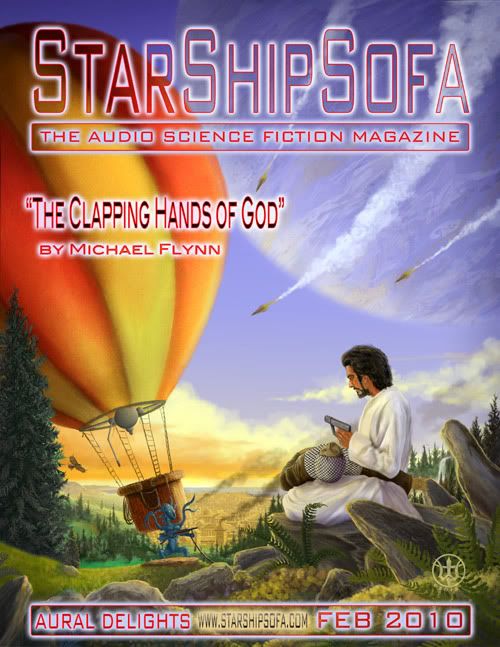
The Clapping Hands Of God by Michael F. Flynn 4/5
Film Talk by Rod Barnett - Daybreakers & The Book of Eli
Commentary on the fact that interesting films are often released in Jan/Feb because studios don't want to release anything that makes money then, and by that they mean big budget crap.
Daybreakers is a post-apocalyptic science fiction vampire film with an excellent cast, and decent effects considering its low budget. Although it isn't a great movie or a classic or anything, Barnett gives it a reservedly positive review because it doesn't romanticize vampires, has a touch of humor, and addresses issues like over-population and depletion of resources. Despite reading a few negative reviews elsewhere, I'm inclined to see this one just for the novelty.
The Book of Eli is about a post-apocalyptic wanderer protecting one of the last copies of The Bible after most copies were burned following whatever wiped out civilization. Barnett likes the treatment of religion and faith in what might have otherwise been a standard action movie.
We're a little light on substance this time, but I'm glad he brought Daybreakers to my attention, and it's interesting to hear about the ideas involved there. The Book of Eli review was pretty slim though. Rating: B

Tuesday, November 30, 2010

The Clapping Hands of God


Novelette by Michael F. Flynn
Read for Starship Sofa by Mike Boris
2005 Hugo Nominee

Hassan leads a team of explorers through a gate onto another world. He is a devout Muslim, in charge of an international exploration/science team with a near-future level of technology. They don't really understand how the gates work, but they open semi-randomly onto many populated worlds. Basically they've developed an international Stargate program.

They set up camp on a mountaintop to study the indigenous people, following a prime-directive-like philosophy of non-interference. They observe the mid-19th century-level aliens with stealth drones and microcameras. One day, the aliens' behavior changes suddenly, and Hassan is forced to wonder if they've been discovered, and how long they can afford to stay. It turns out he has a much more difficult decisions to make.

As someone mentioned elsewhere, it seems Hassan is a science fiction reader, as he encounters and avoids all the standard first contact pitfalls and idiot plots. Throughout the novelette, he reminds his team that the aliens are not human, and we can't ascribe human traits to them or jump to conclusions based on imagined narratives with scant evidence. All the team members are well drawn and interestingly differentiated, and Mike Boris provides different accents and voices for each of them. I was quite impressed with his talent for accents here.

Just as we think the story is going to wrap up in an expected way, the entire situation changes for the more complex. And just when that situation is about to wrap up, it doesn't go how we expect either. The last quarter of this story is excellent, some of the best first-contact storytelling I've ever seen. The whole thing reads like a deconstruction of the standard first-contact tale. The ending is sad, thoughtful, and pragmatic.

4 hands clapping out of 5.

Originally published in Analog, July/August 2004
Anthologized in Dozois' Year's Best Science Fiction 22

Monday, November 29, 2010

Pulp Cover

Short Story by Gene Wolfe
Starship Sofa podcast read by Mike Boris

This story, as explained by the title and at the end, are basically a look at one of the tropes of bad movies and generic cover art of 1950s SF, but with the introduction of Wolfe's subtlety and restraint. A man wants to marry his boss's young daughter, but loses to a handsome, rich, Yale-graduate competitor. Except maybe the guy isn't who he says he is.

This isn't Wolfe's deepest work, but there is still much more to it than your average story. Fear and sadness are much more prevalent than the jealousy you'd expect this story to be about. Somewhat simplistic, there is still an extra twist-beyond-the-twist, and the brevity and openendedness make for an effective horror story. I'm particularly left wondering why the protagonist hired a writer to tell his story (Gene Wolfe, of course!) and why he felt his name had to be hidden, but the world made aware. There is a remaining menace and mystery to what ought to be a bittersweet happy ending, and I really like that.

Primarily a creepy little horror story set in either the 50s or today, but where all the horror is implied, aside from the protagonist's feeling of being generally creeped out. The ending was great, 4 distressed women in tinfoil bikinis out of 5.

Pulp Cover was originally published in Asimov's March 2004.
It was reprinted for the Hartwell & Cramer Year's Best SF 10 anthology.
And again for Gene Wolfe's Starwater Strains collection.

Knotwork

Novelette by Nina Kiriki Hoffman
Podcast by Starship Sofa, read by Christie Yant

When this novelette opened like Sex and the City narrated by some sort of awkward alien woman, I was a little nervous. Noella is an alien or a sort of magical being who has given up much of her innate power to take human form and marry a human man. One day, she finds out he is cheating on her with a girl at the office: J.C.. Finding her marriage vows broken, which were literally powerful, she is able to reclaim her lost abilities.

Noella meets up with J.C. to discuss the situation with Hugh, and eventually comes to forgive her. Together, they are both pretty angry with him though. "Hell hath no fury like a woman scorned" is a more terrifying quote when she borders on all-powerful.
Hugh:"What are you doing?"
Noella: "Whatever I want."
The ending wraps up with Noella still not knowing what she wants to do yet, but I think she's partly forgiven Hugh, and wants to be friends with J.C.. The ending seems darkly happy; I wouldn't want to be Hugh in that situation, but I like to think everyone was happy in the long run.

So despite my initial misgivings, I liked this story a lot. The "knotwork" is a very interesting magical system, but the real highlight is the characters. All three main characters are exceptionally well developed and at least somewhat sympathetic. We get to know about Hugh's mommy-issues, J.C.'s loneliness and low self-esteem, and Noella's lack of understanding of some social signals and emotions. She has an odd touch of the anti-hero about her which I think makes for an interesting protagonist in a story about cheating spouses. J.C., the woman he cheated with, actually comes across as the most sympathetic though, and at the end, it's her future I'm most interested in.

Yant is a good reader for capturing the emotions here, and I suspect she improves the excitement and nuance of the story just with her voice. It does lead me to seeing connections with It Takes Two that aren't really there, but both were good stories.

I like this one quite a bit, 4 knots out of 5.

Sunday, November 28, 2010

The Last Evolution

Short Story by John W. Campbell Jr.

A somewhat dry history of the human and machine war with an invading alien threat. The humans lose and are wiped out, but leave behind machines which continue to evolve. In fact, this appears to be one of the first seeds of the technological singularity idea: Humans create machines smarter than them, who themselves create new even smarter machines, and so on.

The overall money-quote of the story:
"Most of mankind were quite useless"
There is a bit of a theme regarding human inefficiency and how great machines are, but the POV character is a machine, so a justified bias.

I don't mean to pick on Campbell too much, as it was first published in August, 1932, but the physics is hilariously bad. One of the joys I got out of this story was just how terrible the physics was.

Also, there was a segment that reminded me of The Colour Out of Space by Lovecraft.

Overall, not a great story, but interesting in that the singularity was introduced as early as 1932. And that things developed beyond that. Obviously some of my faults with this are just a product of the time, but it still isn't a great story. 2.5 Ultimate Energies out of 5.

Campanella does some great voices in this episode. I honestly think he may have read too slowly or something though, I can't identify how much of the dragging sensation was the reading, and how much the story. It does drag when being read as text, but I think it is slower as audio. Campanella's voicework was great, but I'm not sure it paid off overall.

Wednesday, September 15, 2010

Starship Sofa March 2010


Episode #123: C.M. Kornbluth vs. Mercurio Rivera
Guest Editorial by Jason Sanford: A Change
How the Nebula ballot has improved with the recent change of rules, change is good, vote Starship Sofa!
Explained in 60 Seconds with Megan Argo
Black holes, gravity, and escape velocities. Still nothing we don't all already know. Even simpler than the last one.
Intro to Snatch Me Another by Mercurio Rivera
Publishing history, Associate Editor at Sybil's Garage Magazine, his writing group, and how the story was an expansion of his earlier Dear Annabehls from Electric Velocipede #17/18.
Fiction: Snatch Me Another by Mercurio Rivera 4.5/5
Looking Back at SF History with Amy H. Sturgis
Margaret Cavendish, Duchess of Newcastle-upon-Tyne, 1623-1673, poet, natural philosopher, and correspondent with many members of the Royal Society. She wrote poetry about astronomy, long before it was cool, some of the better examples are read by Amy here. She also wrote a very early science fiction novel, with bear-people on another planet, criticism of chauvinism, and a level of metafiction you don't expect to see until much later. I'm inclined to read both the novel, and a bunch of this poetry some day, and many thanks to Amy H. Sturgis. Rating: A+
Intro to The Adventurer by Lawrence Santoro
Larry reminisces about reading Kornbluth as a kid, particularly his humor and plotting and overall skill. Discusses his tragic early death. Larry says Kornbluth>Asimov>Heinlein>Everybody Else at the time.
Fiction: The Adventurer by C.M. Kornbluth (Classic) 4/5

Episode #124: Will McIntosh
Guest Editorial by Mur Lafferty: Fanzines
Mur makes fun of and points out the irony of science fiction fans and writers being opposed to new technology and internet fiction sources winning awards. She just reads her blog post linked above, but her voice emphasizes her humor and righteous anger. Worthwhile.
Interogation: Gene Wolfe
Wolfe gives a great interview and can talk forever with very little prompting. He talks about his desire to bury other SF writers in his basement, replace them, and claim their work, and about how now that he has been writing for a long time, he is now capable of sitting down and writing about bees if someone is writing a bee-themed anthology. Wolfe addresses how writing works, his process, and learning Ancient Greek. Everything he says seems to be both well-thought-out and humorous. I could listen to Gene Wolfe for hours, and, although I haven't yet, I'd consider donating to Starship Sofa just for the extended interviews for a few more like Wolfe. Rating: A
Fiction: Bridesicle by Will McIntosh 4/5
Observation Deck with Cheryl Morgan
Cheryl Morgan reports from the Library Bar at P-Con (Phoenix Convention). Nick Harkaway is the guest of honor. A summary of what conventions she was on and what sort of breakfast the hotel served. Definitely not worth the 15 minutes. Rating: F

Episode #125: James Morrow
Editorial by Tony C. Smith: Thank You
Science News with J.J. Campanella
Promo: Galactic Suburbia
Fiction: Lady Witherspoon's Solution by James Morrow

Episode #126: Karen Joy Fowler
Editorial by Tony C. Smith: The Interviews
Film Talk with Rod Barnett
Fiction: Always by Karen Joy Fowler

Episode #127: Tanith Lee
Editorial by Tony C. Smith: What Happened to Me This Week
Flash Fiction: iThink by Ken MacLeod
StarshipSofa Stories Vol. 2 Update by Dee Cunniffe
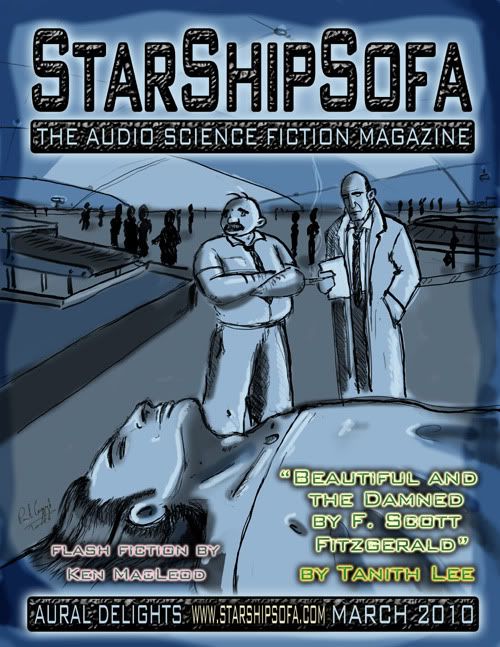
Fiction: The Beautiful and the Damned by F. Scott Fitzgerald by Tanith Lee

Tuesday, September 14, 2010

The Beautiful and the Damned by F. Scott Fitzgerald


by Tanith Lee
Read for Starship Sofa by J.J. Campanella

iThink

Flash Fiction by Ken MacLeod
Read for Starship Sofa by Geoff Michelli

Always

by Karen Joy Fowler
Read for Starship Sofa by Amy H. Sturgis

Lady Witherspoon's Solution

by James Morrow
Read for Starship Sofa by Peter Seaton-Clarke & Nicola Seaton Clarke

The Adventurer

Short Story by C.M. Kornbluth
Free from Project Gutenberg
Read for Starship Sofa by Lawrence Santoro

I wasn't quite as impressed with this story as I felt I should have been. It may be the reek of the 50s, but I find it in my heart to love Asimov and Bradbury, you'd think I would love Kornbluth more. The concept is good and there is a nice layer of satire in the story:

America is a few hundred years into the future, still engaged in a cold war with the Soviet Union. The people are stupid and disinterested, and, more importantly, the president is stupid and disinterested and has become a hereditary position with all the name-only trappings of democracy you'd expect from us. It's really a dictatorship where cabinet members get executed as traitors on a whim, everyone spies on everyone else, and the people are kept in line through a mix of mind-control, terrorism, random executions, and press censorship.

Like some of Bradbury's work, Kornbluth is hating on anti-intellectualism before it was common, although it isn't the center of this story as it is in some of his others. Basically, the cabinet members want to overthrow their idiot-king but are certain they'll fail if they try any of the traditional means. Meanwhile, we read about the seemingly unrelated life of a young cadet.

The last lines are actually very surprising. I'd foreseen the main development, as I'm sure most readers will, but not only are some of the root causes different than we'd have thought, but the ultimate future of the nation doesn't go where I was expecting either. Kornbluth sets us up for one thing, especially given the hopefulness of the era, and then gives us a rather sobering, but probably more likely conclusion. And, again, it was all there earlier in the descriptions and the explanation of the title. I'll be left thinking about the stealth-moral of this story for years, I think. What is the true difference between the conquering hero and the villain?

Still, there is something about Kornbluth's prose that doesn't really strike me here, although Larry's narration is great as always, and this story, at least, isn't quite brilliant or subtle enough to be a favorite. 3.5 Soviet Jovian moons out of 5.

First Published in Space Science Fiction, May 1953

Snatch Me Another

Short Story by Mercurio Rivera
Published free online in Abyss & Apex #25, 2008
Read for Starship Sofa by Liz Mierzejewski

A very dark tale of two parents mourning the loss of a child. One turns to drugs and despair and withdraws from everything, the other goes fairly crazy, and remains happy. Both of these reactions play out to tragic extremes by the end. To complicate matters, this takes place in a near future where we've developed the technology to bring things over from other universes.

Both main characters are well characterized and empathetic in their madness. It's easy to imagine either reaction being your own, although you'd hope to be stronger, or at least more stable. There is a spinning, terrifying, sickening, vertigo feel to some of the description that's much more effective than the bland description so common in stories with this sort of technology. It seems perfectly real, but horribly so. Everything from the clouds to the minister to the drug inhalers at the beginning foreshadows the end and builds on some of the themes.

That said, I'm glad I went back and read this as text. The audio didn't work for me nearly as well here. I might not have given it a second chance if it weren't for the impression of brilliance behind the narration.

I have to say I'm not a fan of Mierzejewski's voice. She does do different voices for the characters, but the two main ones run together at times, I don't really like her voice in the narration, and there is something in her cadence that just sort of bothers me. The speed changes make things a little harder to follow than they could be. She does capture a lot more emotion toward the end though, but there's a singsong quality to the beginning that feels out of place in such a dark tale. It's so rare to be disappointed in a Starship Sofa narration that I'm still a bit surprised.

So, not something for a light mood, but dark and thoughtful and terrible, in the best possible way. Snatch me another story from Mercurio Rivera. 4.5 out of 5.

Sunday, September 12, 2010

Starship Sofa Episodes 111, 112, and 113

Episode #111
Brief Intro by Tony, and a brief outro by Larry Santoro discussing his writing process, his inspiration for the story, and his love of throwing in puns, anachronisms, and subtle pop culture references. Actually this is pretty interesting.
But the bulk of the episode is just Part 1 of Lord Dickens's Declaration.

Episode #112
Poem: Safe in Their Cryogenic Chambers by Lyn C.A. Gardner
An SF take on Safe in Their Alabaster Chambers by Emily Dickinson, the resurrection they are waiting for here is to wake from cold sleep on arriving at the destination of their presumably slower-than-light spaceship. It's only okay in a vacuum, but the correlation with the Dickinson poem definitely adds something, at least for me. If you are going to listen to this episode, and haven't already, I'd read the poem linked above, and think about it for a bit before listening to Gardner' s version. You'll definitely appreciate it more that way. It wasn't written to stand alone, and it's frankly better when Dickinson is there to supplement, but this is a good tribute.
The Sofanaut Awards by Mark Bormann
Announcing the shortlist for the 2009 awards, and a bit about the voting process.
Looking Back At SF History by Amy H. Sturgis - Captain Nemo
A long look at one of the first proto-steampunk protagonists, Jules Verne's Captain Nemo is "A classic Byronic hero ... mad, bad, and dangerous to know... an early emo-boy, action hero, and scientific genius." Perhaps too much time is given to a list of all the actors who've portrayed him, movies, TV episodes, and musical tributes, but this is an enthusiastic, loving tribute to Captain Nemo and a pretty good analysis of his character. It was interesting to learn that He was changed (for the better, in my opinion) after the first draft so as to sell more books in Russia, a funny motivation for a good decision, and a nice bit of trivia. I'd urge everyone to read (for free) the two books in which he appears: 20,000 Leagues Under the Sea, and The Mysterious Island.
Recap of Part I by Lawrence Santoro
Thank Larry for this recap, I missed about half of this on my listenthrough of last episode.
Lord Dickens's Declaration Part II
Update by Spider Robinson
An update on the health of his wife Jeannie and their financial status. Sad but thankful.
Fact Article IPv4 by Simon Hildebrandt
A fascinating article about how we assign our current 32-bit IP addresses, which we're expected to run out of in the next few years. IPv4, our current plan, can only have 6 billion addresses, while IPv6 could assign 10 to every single molecule on the face of the planet. We currently just keep going using a bunch of tricks and stopgap measures, but it will not be enough. We have the technology to fix the problem right now, and most software and hardware is set up to deal with the changes we'll need to make, but countries and large companies are too slow and unlikely to address the issue until serious problems have already happened. The solution is IPv6, and it's something we'll all need to adopt in the next few years. Google, Apple, Microsoft, and router manufacturers know this, as do the Internet protocol guys, but countries aren't getting the hint yet. Hildebrandt gives us a look at the way the system works, the changes that will have to be made, the need to encourage early adoption, and the fact that it probably won't happen fast enough. Great stuff. Rating: A
Film Talk by Rod Barnett - The Box
Barnett opens with a discussion of Richard Kelly's first two films, before he directed The Box. Kelly made a name for himself with Donnie Darko, a film I loved, and Barnett felt he should have loved, but just didn't. Many years later, he followed up with Southland Tales, an unholy abomination of a movie. Which puts the pressure on him for The Box, his third film: does it indicate a comeback from a sophomore slump, or another failure in a likely one-hit wonder career?

The Box is based on Button Button by Richard Matheson, but of course, being a big Hollywood movie, completely screws it up. It's the classic idea of "If you press this button, you'll get a million dollars, but someone you don't know will die." It isn't hard to find negative reviews of "The Box", but I think most of them miss some of the points Barnett gets, possibly due to his awareness of SF tropes and literature. The problem isn't in the initial idea, it is that, in order to stretch it out long enough, Kelly comes up with a bunch of surreal bullshit that isn't in any way relevant. He doesn't add any depth to the plot or the themes or the central moral dilemma, he just throws a bunch of random, unconnected things at the wall in an attempt to give an illusion of depth. I find too many reviewers are unwilling to call people out on this sort of thing, and just attribute their hatred of the movie to other things besides it not making any sense. Barnett's ability to call out this bullshit endears him to me, this is a good review. Although I'm disappointed he can't get behind my Donnie Darko apologetics, I rather have Rod Barnett than Roger Ebert.
Recap of Parts I & II by Lawrence Santoro
Wrap Up by Lawrence Santoro

Saturday, September 11, 2010

Lord Dickens's Declaration


Novella by Lawrence Santoro

Broken up over three episodes of Starship Sofa, podcast for free as always, and brilliantly read by the author himself. It must be pointed out that Larry Santoro is one of the greatest story narrators of all time. If listening to this doesn't convince you, check out his other voice work.

On first listen, the first third is nearly incomprehensible in parts. At least to the ability to understand what the hell is going on. Maybe I was just tired though.

Santoro's introduction to Part II explains the first part much more clearly than it came across actually listening to it, so I'd advise not skipping it even if you are listening back-to-back-to-back, there is a decent chance you missed something important. That said, it is also worthwhile to actually listen to the first third, it isn't that bad.

The introduction to Part III is less vital, but still nice. Finally, the wrap up bit by Santoro is really fun and interesting to listen to, about how he came up with the ideas of the story and went about building it up.

Now, on with the actual story review.
This is an alternate history, steampunk time travel story. Set in a 1902 without religion, where war is something long forgotten, Jesus was a politician, as were Poe and Dickens. Literary historians are at the top of the academic food chain, with math and science at the bottom, filtering up through the softer and softer humanities. Philby is one such time-traveling literary historian, and this is largely the love story between him and his constant rival: Master Mary Mariah. The interaction between the two of them is pure gold. They fight and betray each other and call each other names, and from the very first segment, where my overall comprehension was lowest, I knew they secretly loved each other. That effect is throughout the story the finest bit of writing by Mr. Santoro.

So Philby gets in trouble for traveling back in time without proper protection, as part of his research into Lord Charles Dickens's declaration of love and proposal of marriage to Queen Elizabeth. He thinks it was not true love, just a ploy to get out of a publishing contract. This opening sends us off on an exceptionally weird, fun, confusing, and at times hilarious alternate history adventure. The ending is oddly sexy, and then oddly philosophical, I like the concluding segment quite a bit.

I don't want to give too much away in plot summary, so I'll just wrap this up with the comment that Santoro's ending and opening segments around the story are a pretty good description. There are a lot of little puns and fun anachronisms throughout. The dialogue is snappy even when it is written in Middle English (William of Occam is a favorite character). The steampunk setting is neat, although even more implausible than steampunk usually is (i.e. very). And the overall themes about love, religion, and human nature are neat, but not as well thought out as they could have been.

This is actually something Santoro mentions in his last segment: It's facile fun with ideas, which is unusual for SF which tends to be overly thought out, while Santoro is a horror writer, and they tend to be more concerned with the moments. He also comments that the story seems rough and unrevised, unpolished. I'd agree with the author on all these counts, he basically points out every problem I might have with the story. And yet I quite like it. SF often isn't as well thought out as people would like to think, and humor certainly has it's place.

I regard this story as primarily humorous, with some deeper thoughts lurking unexplored around the edges. It is good, light fun. The first third is confusing and overly complex and the segment most in need of revision. The second third was the most funny and worked the best overall I thought. The third third is a little more serious and deep, while still being lighthearted, although it could use some trimming here and there. But it is a good story, especially for what it aims to do.

I don't think I'm cutting Santoro any slack for writing on a deadline when I recommend this novella with 3.5 disaccommodated, illusory timelines out of 5.

Oddly, the biggest thing I take away from his explanation at the end, is how hard it is to swear and cuss people out without Gods or the concept of eternal damnation. I would suggest he could use vulgarity though.

Best Quotes:
  • "Few heeded Darwin anyway."
  • "Oh lovely twin-backed beasts."
  • "I am persuaded that Elizabeth, among her many virtues, was not a virgin."
  • "Nothing seems to improve a thing like making it larger."