Showing posts with label Hugo Nominees. Show all posts

Monday, September 26, 2011

This Moment of the Storm

Novelette by Roger Zelazny

"Suddenly, it was very dark and there was only the rain."


Zelazny's description of the aftermath of a lightning strike could also double for a description of the turning point in the story where it appears.

This is one of my favorite stories, but one I sometimes have trouble recommending (although given the resemblance of most best-selling novels to cinderblocks, I probably shouldn't.) The writing itself is brilliant throughout, alternating the humor of the opening and foreshadowing the terrificly melancholic end around worldbuilding I still find interesting 65 years after Zelazny came up with it. The story is emotional and thoughtful and even a bit understated in parts.

Literally the only fault I find with "This Moment of the Storm" is that almost nothing happens in the first 2/3 of the story. It's all worldbuilding and character work and setup. All of which is engaging and well done, but it seems a bit slow. The first time I read this, I honestly found myself wondering if anything was going to happen in the story, or if Zelazny was just setting up a neat colony planet to describe hurricane flooding with time out for philosophy. And then, suddenly, everything happens in the last 1/3 of the story. It almost seems as if the slow build is there to make the ending that much more shocking. And where I'd usually wish I'd just skipped the first 2/3, everything that comes before is absolutely vital to the ending. I wouldn't want it a single word shorter.

I'm not sure exactly what I'd call the climax of the story, but I'm sure it doesn't take up more than a line or two. Everything after the line I opened with is short, dark, and devastating. We are moved from humor and love on a world ravaged by a record-setting rainstorm to what may as well be news footage of Hurricane Katrina in New Orleans with a slight SF tinge.

Here the narrator explains his dismissal of the definitions of humanity from the philosophy-class introduction.

"Man is the reasoning animal? Greater than beasts but less than angels? Not the murderer I shot that night. He wasn't even the one who uses tools or buries his dead."

Terrible things happen, but eventually the storm clears and recovery can begin. But the narrator finds that the storm has washed away what little progress he had made toward happiness, too. He ends the story, emotionally, in the same place he was before it began. Here are the closing lines, which cinch this one as a personal favorite:

"Years have passed, I suppose. I'm not really counting them anymore. But I think of this thing often: Perhaps there is a Golden Age someplace, a Renaissance for me sometime, a special time somewhere, somewhere but a ticket, a visa, a diary-page away. I don't know where or when. Who does? Where are all the rains of yesterday?

In the invisible city?

Inside me?

It is cold and quiet outside and the horizon is infinity. There is no sense of movement.

There is no moon, and the stars are very bright, like broken diamonds, all.

5 out of 5 philosophy professors are familiar with the time-killing method Zelazny explains here, for whenever they misplace their lecture notes.

Thursday, January 20, 2011

Tuesday, November 30, 2010

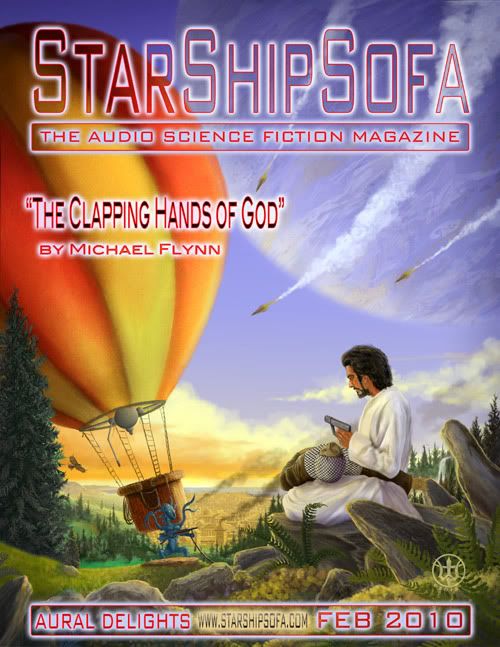
The Clapping Hands of God


Novelette by Michael F. Flynn
Read for Starship Sofa by Mike Boris
2005 Hugo Nominee

Hassan leads a team of explorers through a gate onto another world. He is a devout Muslim, in charge of an international exploration/science team with a near-future level of technology. They don't really understand how the gates work, but they open semi-randomly onto many populated worlds. Basically they've developed an international Stargate program.

They set up camp on a mountaintop to study the indigenous people, following a prime-directive-like philosophy of non-interference. They observe the mid-19th century-level aliens with stealth drones and microcameras. One day, the aliens' behavior changes suddenly, and Hassan is forced to wonder if they've been discovered, and how long they can afford to stay. It turns out he has a much more difficult decisions to make.

As someone mentioned elsewhere, it seems Hassan is a science fiction reader, as he encounters and avoids all the standard first contact pitfalls and idiot plots. Throughout the novelette, he reminds his team that the aliens are not human, and we can't ascribe human traits to them or jump to conclusions based on imagined narratives with scant evidence. All the team members are well drawn and interestingly differentiated, and Mike Boris provides different accents and voices for each of them. I was quite impressed with his talent for accents here.

Just as we think the story is going to wrap up in an expected way, the entire situation changes for the more complex. And just when that situation is about to wrap up, it doesn't go how we expect either. The last quarter of this story is excellent, some of the best first-contact storytelling I've ever seen. The whole thing reads like a deconstruction of the standard first-contact tale. The ending is sad, thoughtful, and pragmatic.

4 hands clapping out of 5.

Originally published in Analog, July/August 2004
Anthologized in Dozois' Year's Best Science Fiction 22

Wednesday, June 30, 2010

The Moment

Short Story by Lawrence M. Schoen

An imaginative but overly long future history of alien intelligences observing a human footprint on the moon. First a post-singularity feeling "archaeocast", then a civilization of sentient dust-sized clones who fight inter-clone wars, followed by a cannibalistic broccoli prince, a medical gastroforensiology peer review choir, an intelligent library protocol, some cometary auditor particles who have been imbued with animal cunning and accounting skills, and finally a coterie of proto-godlings and their tutor end up tracing back the history of the place and the special significance of humans as compared to all these other aliens.

Everyone has read this "humans are so special because X" kind of story a million times before, and it is no more profound or meaningful or moving this time around, but at least the imagination is better. There is a certain dry humor to many passages that I appreciate, and the aliens are well imagined and different, but it's all imagination and no substance.

The only memorable thing about this piece is the concept of medical journals being reviewed by a group of researchers and choral directors. There are some cool (but irrelevant) concepts, and some chuckle-worthy lines, but overall, there's nothing to see here.

2 cases of fatal cannibal indigestion out of 5.

Available online on the author's website
Podcast by Escape Pod read by Graeme Dunlop
Originally published in Footprints

The Bride of Frankenstein

Short Story by Mike Resnick

Podcast by Escape Pod read by Julie Davis
Originally published in Asimov's

The Baroness von Frankenstein can't stand an uppity creature, and wonders why didn't she marry a doctor or a banker instead of a mad scientist. She's cold and bitchy, but when the delightfully sarcastic Monster takes an interest in romance novels, he catalyzes some much needed introspection.

Undead creatures are an underused resource for self-improvement and marriage counseling. It was a good central conceit, and the story was decently funny, and a bit moving, but I don't think it's worthy of a Hugo. It was too saccharine, a bit obvious and not quite funny or thoughtful enough for that. Resnick is no Mel Brooks.

The Escape Pod podcast definitely seems better than the text story here. Julie Davis does pretty good voices, I'm particularly a fan of her Igor, and she captures a proper scientist-type enthusiasm for Victor in the lab scene. The Baroness is delightfully cold and haughty. Alasdair had a good outro, as usual, but I may be biased by my love of Spaced. And my opinion of this story may be slightly higher due to the reader and my love of Young Frankenstein.

Only 3.5 out of 5 romances end in tragedy. We've gone soft.

Saturday, June 19, 2010

Vishnu at the Cat Circus

Novella by Ian McDonald

My personal favorite of the 2010 Hugo Award novella nominees.

Vishnu is a bioengineered genius in a future India ravaged by drought and the technological singularity. Now the proprietor and ringmaster of his "Marvelous Magical Magnificent Cat Circus!", he makes a living telling stories and showing off his trained cats.
"All they do is run in a circle? Brother, with cats, that is an achievement. But you're right; running in a circle, nose to tail, is pretty much the meat of my cat circus."

The story he tells within this frame is the bulk of the novella. It is the story of his life, from his parents falling in love while escaping killer robots, to his nearly deadly sibling rivalry with his naturally brilliant brother and both of their rise to the top of business and politics (and Vishnu's implied fall to the bottom). Vishnu's life might be approaching too much detail, but it is pretty interesting, and even more interesting is the background technological advancements and the exploration of an underused cultural background. McDonald's near-future history of India is one of the biggest draws in this novella in particular, and in the Cyberabad Days collection in general. But this is my favorite bit of extrapolation in the collection. Not only does it go a bit farther, it covers some new and unique ideas.

But the best part by far is Vishnu's interspersed bits of present-day storytelling to the hypothetical audience. He is humorous and more interesting in voice than his younger, more naive self, and his talk to the audience is used for meta-commentary to the reader, not only about symbolism, but about story structure and the reality of heroics.

This is a dark series of predictions, but it is fairly funny and extremely interesting. There is lots of recurring water imagery, as well as the metaphor of striking a diamond correctly to split it, or incorrectly and ending up with a pile of shiny, useless dust. But the main theme, to me, is how we forget about and ignore the poor as our march towards progress increases the divide between the haves and have-nots. And how there might not be that much they can do about it, they might just be screwed.

Although the last paragraph doesn't especially impress me, I love the conclusion overall. We aren't sure whether Vishnu will succeed or not, and we certainly don't get his metafictionally-promised big confrontation with a villain capable of a long, drawn-out dramatic death scene. But we have despair, and hope of a partial solution and some great meditation on heros, villains, and resolution. And maybe that is enough. 4.5 feline incarnations out 5.

Friday, June 18, 2010

Palimpsest (Novella)

Novella by Charles Stross

Originally published in Wireless: The Essential Collection

For a Novella, there isn't really enough to this story.

It is a brilliant bit of worldbuilding, especially the ideas behind how the stasis works and how they plan to keep Earth alive for so much longer against the natural lifespan of the galaxy. The time travel mechanism required by the narrative is an interesting and slightly different one and I enjoyed how Stross explored that. The "Brief Alternate History of the Solar System" segments were particularly good.

I do have a few problems with this novella, however. The second person narrative bits at the beginning of most chapters are pointless and annoying. I realize Stross wants to differentiate the possible alternate Pierces from "our" Pierce, but he doesn't really achieve this until the last few times, it remains annoying-as-hell even after we get it, and really how does making alternate versions of a third person narrative into second person make any sense anyway. Use a different font or something, I don't know.

Besides that, I was a bit annoyed by the invocation of Kafka, both as the appearance of the Internal Affairs guy and with a section called "The Trial" in which he appears. There wasn't enough actual reference to Kafka's "The Trial," or any other bit of his writing to justify this. There was bordering on 0 reference to Kafka besides Stross name-dropping him a few times. It annoys me when allusions are made to things like this for no good reason, and not really tied into the writing in any other way. If he wanted to have a guy look like Heinlein, I'd have loved it. Or if he wanted to really reference "The Trial" a lot in that section of this novella I'd have been okay with Kafka. But I don't like the randomness of what could have been a meaningful literary allusion. It seems like it just wants to name drop a bit in hopes of sounding more thoughtful.

Which is too bad, because the story is pretty thoughtful as it is. I love a good time travel story, and this one is intense, suspenseful, and has possibly the grandest scale and best sense of wonder I've ever experienced from a time travel story. But there isn't much more to it. Like I said, this piece oozes Heinlein.

So I'd recommend that anyone who enjoys time travel stories (or Heinlein) even a little bit should read this one. But I can't recommend it as an award nominee. 4 out of 5 paradoxes overwritten.

Thursday, June 10, 2010

It Takes Two

Novelette by Nicola Griffith

Originally published in Eclipse 3
Podcast by Starship Sofa, read by the Christie Yant.

Cody is a female executive trying to close a big contract and get a promotion. She's a lesbian and in order to seal the deal, her southern good ol' boy client insists on taking people to a strip club. Some kind of weird test. Cody is understandably uncomfortable with the whole setup, both the strip club in general, and the guys watching her watch the girls. Then Cookie takes the stage and Cody falls madly in lust.

This is almost a love story. But rather than the point being "happily ever after", it's philosophical about what love, lust, and attraction are. The setting is two-weeks-into-the-future.

I'd recommend the audio over the paper version: Yant is a good reader, but more importantly, the awkward exposition bit 2/3 into the story is less awkward when listened to. And the sex stuff is less generic-erotica-sounding than it reads on the page. But I might be biased because Yant sounds like a friend of mine.

I can't say much more without spoilers. And they matter to this story. So go listen/read if you're going to. This is definitely R-rated, if that matters.

Anyway I do recommend this, but not unreservedly: 4 eccentric strip-club-loving businessmen out of 5.

My likes, dislikes, and general thoughts on the story (with spoilers) are well mirrored by this review. So rather than make the internet more redundant, I'll just post the link and for the sake of posterity, quote the relevant part of Abigail Nussbaum's Strange Horizon's review in white text on white background (highlight to read):

Nicola Griffith's novelette "It Takes Two," ... is one of my very favorite stories from 2009. It also doesn't really work.

...

After several pages of Cody and Cookie (real name Susanna) simultaneously marveling and rejecting their undeniable chemical response to one another in slightly clichéd terms ("'Do you suppose this is l—' She couldn't say it. She didn't believe it."), Cody returns to San Francisco and is accosted by her friend Richard, and for the next ten pages or so "It Takes Two" mainly consists of Richard explaining the story's McGuffin and Cody reacting with varying degrees of alarm, disbelief, and horror to the revelation that she hired Richard to prime both herself and Susanna with each other's sexual and romantic preferences and fantasies, essentially manufacturing love at first sight. Even leaving aside just how convoluted and tenuous a method this is of securing a deal (are there really executives, even Atlanta good ol' boys, who will sign a deal with someone because "I like the way you handle yourself . . . no boasting, no big words, you just sit quiet then seize the opportunity"?) the structure of the story is off: story, story, story, exposition, exposition, exposition, dilemma—as Cody has to decide whether to take what Griffith rather cleverly dubs "RU486 for the brain" and destroy her artificial feelings for Susanna, or embrace them.

Why then, do I still think that "It Takes Two" is a brilliant story? Because it is just so damnably creepy. We all know, even if we don't like to be reminded of it, that even the loftiest of emotions are chemical fluctuations in our brains, and that those chemicals can and are being manipulated on various levels and with various degrees of finesse. What makes "It Takes Two" disturbing is not so much that it adds love to the list of reactions that can be externally, medically controlled, but that it takes the obvious next step of assuming that once that ability is achieved it will be commodified, that the next step in prostitution will be whores who really do mean it when they say "you're special, I wouldn't do this with anyone but you" (in that sense "It Takes Two" covers much of the same ground as Joss Whedon's recently cancelled Dollhouse). "It Takes Two" doesn't shy away from the fact that Susanna has sold herself in the most profound way possible, and that Cody has bought her, but at the same time it encourages us to root for a romantic ending. The resulting tension between romance and revulsion is what makes the story, what makes it possible to ignore the problems in its premise and structure, and what makes its ending simultaneously satisfying and horrifying.

Tuesday, May 18, 2010

The God Engines


Novella by John Scalzi

It was time to whip the god.
Easily the best opening line on either this year's Nebula or Hugo ballot.

This novella is John Scalzi's first attempt at Fantasy and it's definitely a success. I prefer this to his science fiction books, and rather than "high fantasy", The God Engines is what Scalzi calls "dark fantasy". It's a horror/fantasy hybrid set mostly on a spaceship. Which I suspect is much more to my liking.

Captain Tephe commands the Righteous, a Ship of the Line in the space fleet of a galactic empire level theocracy. The title of the novella is meant literally: rather than some kind of Phlebotinum, the ships and their FTL capability are powered by the enslaved gods of conquered civilizations.

The story opens with the god engine of the Righteous acting up. After disciplining it, they are called back home and assigned a high priority, top-secret mission. This is where the focus moves away from the fantasy worldbuilding to the simmering menace beneath pretty much everything, eventually progressing to all-out horror. The return to the ship after being assigned the mission marks the boundary between mediocre story with an interesting setting and can't-put-it-down, finish-in-one-night horror story with some points to make about trust in your superiors and blind faith in general.

I don't want to reveal specifics, but there are several major world-shifting revelations, all of which are foreshadowed but still surprising. As the whole tone of the story would lead you to believe, the ending is not a happy one. But it is amazing. The last chapter is what makes the story for me and in that sense, despite the length, this novella lives up to Edgar Allen Poe's definition of a short story in that it is all about one big effect (and that I, at least, read this is one sitting, albeit a long one).

That said, surprise and revelation aren't everything, the tone still creates a nice horror effect and The God Engines is equally enjoyable on a second reading.

The theme is really one of the folly of blind faith and how, even still, people cannot let go of it. Definitely some material worth thinking about once you know the whole story of how the world works.

I've seen some criticism of the characterization and perhaps the secondary characters are underdeveloped, but not to the detriment of the story and not any more than is justified given the short length. Tephe and his obnoxious priest rival are quite well drawn, to the point where captain Tephe takes a course of action towards the end of the story that never would have occurred to me, and I find it completely believable for his character. A flat character would have me blaming the author for manipulating things for the sake of plot, but this feels natural.

A note on the physical book: I really like everything about it. The dust jacket art, the page design, the paper and especially the four pieces of internal artwork. Scattered through the book there are four full-page illustrations of key scenes. They are well drawn and look good in the book, they just fit in well. The scenes chosen are good ones to illustrate and three of four are in the first half, where illustration aids in the worldbuilding. I think they are a nice touch and between all these factors, this book has convinced me to buy more things from Subterranean Press in the future.

While I was apprehensive for the first half of the novella, given some clunky dialogue and far too much exposition, things were interesting enough to keep me reading. The later half more than made up for the weakness of the beginning. The menacing sealed-evil-in-a-can feeling of the Righteous's god justified the blurb on the back comparing this to Lovecraft and was impressive in itself. The conclusion went on to top my expectations. 4.5 out of 5 and my favorite for the Nebula novella category.

Sunday, May 16, 2010

Shambling Towards Hiroshima


Novella by James Morrow

This has been reviewed to death elsewhere, due partly to it's Nebula and Hugo nominations, and partly due to being James Morrow. An index of other reviews can be found here.

My only comment in regards to reviews is that people thinking anything can be inappropriate subject matter for satire or humor is just plain wrong. Humor can be done tastelessly, but it can't be inherently off-limits by topic. And James Morrow is not tasteless. Actually his handling of the sensitive issues here is quite delicate.

Syms Thorley is a B-Movie actor during WWII. The Navy hires him to help demonstrate their giant, fire-breathing lizard project by dressing up in a lizard suit.

Many reviewers remarked on the change in tone at the end of the novella. This is really the difference in tone/theme between the historical memoir and the framing device. Towards the last 1/5 or so, the memoir wraps up and what was initially the framing device becomes the entire story. The memoir is the bad horror movie/military weapons project satire that the book is generally described as, while the framing is established with the opening sentence:
"Whether this memoir will turn out to be the world's longest suicide note, or instead the means by which I might elude the abyss, only time can tell...".

So this darker suicide central story is sprinkled throughout, and we learn what happens with the war effort long before we learn what I see as the central question: whether Syms will kill himself or not. And on this front the book particularly impresses me. I was genuinely surprised several times in what I expected to be a very predictable substory. And perhaps the most tragic moment in the entire book made me laugh. And then feel bad about it, but it was funny, dammit. That is the real pleasure of this book. Essentially it is a book about suicide and about how nuclear weapons are both horrible and stupid. And it makes its points while being one of the funniest things I've read in some time. Not Douglas-Adams-style absurdity, more Vonnegut-sarcasm. And I use Vonnegut not only because it seems apt in the style sense, but because Mr. Morrow mentions on his website that he loves/hates that comparison: unlike Vonnegut, Morrow actually likes people.

Overall, a very funny novella, but one where you need to think, not just to get the jokes, but to get through the serious points. You don't need to know anything about B-movies, 1940s actors/producers/directors/screenwriters, the Manhattan Project, WWII, Edgar Allan Poe, Ray Bradbury, or comic/SF conventions, but they all add to the experience. Well a passing knowledge of Poe and WWII and monster movies may actually be required. But not too much is needed.

4.5 out of 5 actors don't realize how easy it would be to pick up chicks in a giant lizard suit.

Thursday, May 13, 2010

Sinner, Baker, Fabulist, Priest; Red Mask, Black Mask, Gentleman, Beast

Novelette by Eugie Foster
WINNER: 2009 Nebula Award
Originally Published in Interzone #220

Starts off as a bizarre fantasy setting that leaves you with a bit of confusion about how gender works in this society, then moves into a unique variation on dystopian SF before an absolutely perfect, shocking, ending. The setting in itself is enough to maintain interest and just exploring that and the implication of the masks would be plenty interesting. The expected musing on identity is present and better handled than typical of a story about masks, and most importantly, not the entire point of the story. And I just can't get over how much I love the ending.

Revealing much of anything would ruin things, but the story is about a society where citizens change masks each day, and with the masks change their entire personalities and lives. They live as the masks. There was some debate online over whether the characters were human or not. I take the minority position that they are in fact human. Given the level of engineering implied by the story (medical, neurological and technological), I have no trouble believing that the obvious changes from our current biology and psychology would be possible to engineer into the species and that the history we get in the story indicates a society that might do such a thing. By Occam's Razor and the lack of anything indicating otherwise I assume human, and I just like the implications of the story even better given that assumption.

I keep wanting to get away from talking about the narrators of podcast versions of stories, especially when dealing with things like the Nebulas where not all nominees were podcast and I'm comparing them. But Mr. Santoro did an amazing job with the narration in this, and properly I should be calling it voice acting. The story doesn't really need anything to be added to it by the reader, but Santoro does it anyway. He expresses anger, fear, lust, confusion and switches from one emotion to another as easily as changing a mask. Particularly notable: he makes great use of stutters in the speech of the main character. Hesitations and repeats covey much more than you'd think.

This story hit me hard even on the third consecutive re-read, and I've loaned the CD I burned of the podcast to several friends. I can't recommend it highly enough. 5 masks out of 5.

Tuesday, May 11, 2010

Spar

Short Story by Kij Johnson
WINNER: 2009 Nebula Award

Vulgar, horrible, beautiful. An astronaut crashes into an alien ship. It rescues her. But it is a tiny ship and the alien is amoeboid. So they have constant sex with varying degrees of consent until they are rescued and can stop occupying the same space. The whole terrifying thing is a metaphor for a bad relationship, or maybe she just projects her feelings for her boyfriend who left her onto the alien. Maybe it isn't even intelligent. It is her sex toy/houseplant, and she is its. By the time they ever get anywhere, the thing will be her whole world.

This is like reading a detailed account of psychological breakdown under torture. But I liked it. The language was vivid and the horror of being in such a close space, with no contact, no communication, and this thing was very well done. And I love the title. 4 Ins out of 5.

Sunday, May 9, 2010

Non-Zero Probabilities

Short Story by N.K. Jemisin
Podcast read by Kate Baker

I'm still not terribly impressed with Ms. Jemisin. It baffles me that this got both a Nebula and Hugo nomination.

It was an okay story; probability in New York City changes so that things on either end of the good-bad bell curve are more likely than things in the middle. So unlikely good and bad occurrences become the norm. There is some mention that human thought is altering probability, which explains to some extent the linking of these things to good luck charms/bad luck omens. Because of this concept, millions of people are going to get together and pray the situation out of existence with sheer force-of-belief. Our heroine gets a boyfriend, and the story ends before anything is resolved (for the better I think).

The probability changes seem off to me in a couple of ways. As a math person, I just can't cope with how Jemisin thinks of probability and it breaks the story for me. Based on the use of probability alone, I'd give the story 1 out of 5 in anger, but I'm trying to reign that impulse in.

The Principle of Indifference is completely ignored, to the point where rolling snake eyes is seriously treated as being more unlikely than a pair of twos or a one and a six. This sort of thing drives me crazy, and is at the heart of all the changes to probability. There is also a shade of Gambler's Fallacy here. I suppose you could explain these away with the idea that the changes are being caused by people's beliefs and people tend to be full of bad reasoning. But that seems like a stretch and isn't really how things are portrayed here. It mentions scientists think this, but that isn't how any of the characters treat things, and it doesn't seem plausible that people's beliefs would cause probability to act this way (given that probability is changed by people's beliefs). I think the author just has issues with how probability works.

So the concept of what was and was not unlikely in this world drove me completely nuts, but the writing was good. Sadly, the plot wasn't, but it could have been worse. It's has all world-building and nothing happens. Maybe we are supposed to think Adele has changed in her ability to cope with the world, but she seems the same at the start and end of the story. The big external event never actually happens in the story, but that is probably for the better, because I can't see how believing things won't be the way the are will fix things, since the instant people were able to change things with their thoughts, there was no reason they would expect change to happen, yet it did.

1.5 out of 5, this one is an outlier on the "crap" end of the bell curve.

Sunday, January 24, 2010

Bridesicle

Short Story by Will McIntosh
Published in Asimov's
Later Podcast by Starship Sofa, read by Amy H. Sturgis

What happens when we have the technology to wake up all the cryogenically frozen people? Fixing whatever killed them is sure to be expensive, so who'd really want to waste the money? Lonely/creepy old men of course!

Mira wakes up after her car crash, confused and disoriented, in a "dating center". She finds out that the only way to get revived is to convince a random man to marry her. Except she is a lesbian. As one of the older people stored in the dating center, she doesn't get many visitors wanting to wake her up for a date, hundreds of years pass between prospective husbands. Eventually she finds out her true love is frozen in the same facility. The question remains, is death somehow better than loveless marriage? Probably not. Takes the whole "I'd rather be dead than sleep with you" comment to a new level of seriousness.

Anyway, the story has a much nicer ending than the downer I'd probably have wrote, but it is still a good one. There is a small subplot about just what happened in the accident, and I found the whole marriage-for-revival situation to be suitably horrifying-yet-plausible. Well done. Just one question: WHY ARE THERE NO LESBIANS IN THE FUTURE? Seriously, this isn't even remarked on, everyone takes the whole bridesicle trade as male exclusive without a second thought. Our protagonist is a lesbian, but when she brings it up, everyone is doubleplus shocked. And nobody ever thought to ask.

Despite the conspicuous, unexplained absence of homosexuality in a future liberal enough to allow fluorescent orange-skinned lawyers, I'd give this horrifying future/bittersweet love story a 4 out of 5.

Monday, January 11, 2010

Act One

Novella by Nancy Kress

This has now been nominated for both the Nebula and Hugo. I went back to see why I didn't like it, because I couldn't remember anything besides there being a dwarf and some genetic terrorists. On second thought, that is reason enough for it not to win awards.

This one is going to join Gunfight on Farside as a good story that I liked, but not nearly as much as internet/reviewer/best-of-collection-editor consensus indicates I should. 3 out of 5.

The strange thing is I can't really identify why. The protagonist, Barry, is an excellent, well drawn character. Imagine Toby Zeigler washing out of politics and deciding to become an actress's manager. Also he's a dwarf and has to think about genetic modifications and free will.

I love this sort of character, I love genetics, the ethical issues brought up by the story are important,
every character is excellent, the plot is plausible yet surprising. The only complaint I can come up with is that the ending is maybe wrapped up a bit too fast, but I see no good way to make it longer, and it does make you think. There is really nothing wrong here, but I didn't love it, I only liked it. Kress is an excellent writer, and you can certainly see that in this story, yet it lacks the punch it ought to have for me.