Showing posts with label Novellas. Show all posts

Tuesday, October 11, 2011

The Man Who Bridged the Mist

Asimov's October/November 2011 CoverNovella by Kij Johnson

Construction story turned love story. Kit is the architect sent by the empire to build the first bridge across a corrosive river of some sort of mist dense enough to sail a boat across. Rasali operates the ferry which Kit's bridge will put out of business, if she doesn't die an early death to one of the giant "fish" living in the river first.

More than just romance against an intriguing fantasyish SF background with 19th century-level technology, Johnson makes a mega-construction project interesting without any of the predictable disasters, terrorist plots, or over-the-top human drama. She makes a better story by focusing on just the normal difficulties of large-scale construction, and a quiet character-study of the architect himself.

Lots of obvious thought about how the bridge changes the town and the townspeople illustrates the deeper theme: how the bridge changes Kit himself. By the end of construction, I think he's more capable of happiness than he was before, but he's certainly not on the path he originally imagined for his life.

The story is aptly titled, it's all about Kit, but the rest of the novella: the world around him, the townsfolk, the details of construction, the mystery of the mist and the Big Ones living in it all provide a fun background for a character-study of a mildly-unhappy man who builds big things.

4 Medium-Large Ones out of 5.

Saturday, August 6, 2011

Coordinated Attacks

Novella by Kristine Kathryn Rusch

Another forgettable Rusch novella. It takes place in the Retrieval Artist universe, but I haven't read enough of those to notice much significance to this. Nor do I particularly want to. Rusch isn't a bad writer, but I don't think she's terribly consistent. A bit too caught up in making everything into a never-ending series to really get the most out of some of her ideas. This one is set on the moon in the future, but it doesn't feel like the moon and doesn't need the SF setting for anything besides getting a few more Analog novellas out of it. The presumably fit protagonist also struggles overly much with an uphill climb and lifting an injured woman considering moon-gravity. This annoys me, almost as much as my suspicion that the setting is there only to serve a more arching multi-novella plot I'm not that interested in.

Anyway, it's a competent pair of police procedural stories, an investigation into a developing series of terrorist attacks interspersed with flashbacks of a murder investigation from four years ago. The terrorist case is never solved, ending with a crisis averted and a lead to follow in the next novella. The murder case is frustrating in that all the clues observed turn out irrelevant, and aren't dealt with at all, merely resolving the mystery with the guilty party attacking the cops and thus establishing guilt. These aren't so frustrating if we look at the story as a character study of Detective Bartholomew Nyquist, but his transition from disaffected grumpy detective to heroic slightly-grumpy detective is left largely unexplained, details presumably to be filled in with the undoubtedly upcoming novella about an attempt on his life which Rusch mentions about ten times, but refuses to elaborate or give any detail. He is an interesting character, if a bit standard-issue, but Rusch seems to be saving a lot of the interesting bits of characterization to dole out in three or four more novellas.

Despite all my complaining, this is a decent thriller. I was unable to stop reading, even when my primary interest, if asked, was what connection the two mysteries had in common to justify their presentation as one story (not enough). The sort of story you can't put down, but once finished, wonder where your forty pages went. I honestly can't remember what took so many pages, or figure out how I failed to notice or get bored. But the fact is I wasn't bored. I just doubt I'll remember this story six months from now when the first of infinite sequels is published. And I'm a little bitter about the obviously serialization-induced name dropping, excess characters, and lack of detail in backstory, in case you didn't pick up on that. Still, not awful to read, just not worth your time unless you love all Rusch's work indiscriminately. And this is still legitimately more interesting and suspenseful than some.

2.5 assassinated moon-mayors out of 5.

Sunday, June 12, 2011

Kiss Me Twice

Novella by Mary Robinette Kowal

A science fiction mystery/thriller, but so much better written than I've unfortunately come to expect from that genre combination. The science fiction is important. Not just vaguely justified enough to be a Kristine Kathryn Rusch mystery, but actually integral to the plot. Two separate crimes rely on the science fictional technology of this world, and it's also key to the action climax. These events simply could not play out without AIs and a central computer coordinating surveillance cameras and databases for the police.

And actual SF social/political issues are addressed! Is it dangerous how much the police have come to rely on technology to do so much of their work for them? How might AI civil rights play out, given the types of jobs we'd invent AIs to handle? What are the dangers of big, centralized police databases? These aren't all heavy themes of the novella, but they are all addressed, and one of them is a rather big deal.

And Kowal writes a much more enthralling mystery/thriller than I've become used to. Her novella is filled with big, perspective altering plot twists. The whole case changes direction a few times, and the feel of this structure reminds me much more of the noir detective stories it invokes, rather than the standard mystery novel. I also get the feeling I associate with Philip K. Dick novels, like the floor just dropped out from under me. Kowal isn't weird enough to truly remind me of Dick's writing, but the plot twists hit me almost as hard. This twistiness is impressive, I'd love to see more SF mysteries from Kowal, rather than the fantasy she seems to be focussing on (not that it isn't good fantasy).

The Mae West references flow fast and furious, but actually tie into the plot, rather than just being flavor, as I worried at first. Although they are mostly flavor. I also like that one minor character is referred to only as "the thin man" a few times. Anyway, this is well worth the large number of pages it takes up, and I hope to see more novellas like this, rather than the usual long, boring murder mysteries where the SF is incidental and the author doesn't play fair with the reader. Throughout, we know as much as Huang does, and can sometimes beat him to a conclusion. This is fun. Read it.

4 Mae West quotes out of 5.

Tuesday, April 19, 2011

Hiding Place

Novella by Adam-Troy Castro

A sequel to a story I haven't read that doesn't read like it. I only found out this was a sequel at the end. References to past events clued in other readers, I'm sure, but they could have been background, and everything we need to know about the character is presented in-story, a nice change for series stories! And the narrator is a complex, interesting person. But that's about all the nice things I have to say about "Hiding Place", unfortunately.

Castro presents us with a very intriguing ethical/legal question, which, combined with the character of Andrea, made me think this might be an installment of Law & Order: IN SPACE! that I could finally get behind. It wasn't.

Castro asks what should be done if a man commits murder, admits it, and then ceases to exist by having his personality merged with with two innocent people into a hive-like consciousness. 2/3 of the people are innocent, but a murderer is getting away with murder! Sadly, Castro doesn't bother to answer this question, or leave us wrestling with an ambiguously unjust solution. He ties everything up with a neat little bow to avoid having to actually deal with the question at all. Were set up for deep thoughts, ethics, and legal arguments, and then denied an honest or thoughtful solution so we can have a non-ambiguous Hollywood-happy ending. It feels fake, over-convenient, and dumbed-down.

On top of that, parts of the story play out like a murder mystery to be solved after the fact, but this whole mystery ends up hanging on pronouns and linguistic technicalities related to pronoun-confusion when talking about multiple personalities. It feels cheap, again, and there is no reason for the witnesses to have to adopt the AbsoluteLiteralTruth to deceive the police instead of just, I don't know, lying. Oh, but it makes for a good mystery to solve on a linguistic technicality, so I guess that's a good reason.

Also, you'd think A SPACE STATION FULL OF LAWYERS would be better at picking up on subtle linguistic loopholes. It's pretty much what they do.

2 mind-linked lawyers out of 5.

Wednesday, February 9, 2011

Killer Advice


Novella by Kristine Kathryn Rusch

Far too many characters arrive on a space station after their ship has caught fire and three passengers have been murdered. Then there is another murder on the station, and the prissy hotel manager and drunken station doctor team up with one of the ship's crew to solve the murder.

Not really the Agatha Christie bottled up murder mystery we're set up for. The reader has no information to help with the actual solution until the last two pages, and neither do any of the characters. The characters themselves are mostly broad types, although the central two are a bit more interesting. Viewpoints shift among a large number of characters throughout, which is interesting in that Rusch shows us that other people don't see certain characters the way they see themselves.

But most of the characters are barely fleshed out, all the viewpoints make us fairly certain none of those characters did it, leaving a whole mess of others we don't know or care anything about as the only suspects. We have almost no information on any of the passengers that aren't viewpoints at one time or another, so we can't really suspect or not-suspect them, or indeed care about them at all. Combined with not really caring about the viewpoint characters either, and the relatively nonviolent method of death, I didn't experience the least suspense while reading, and bordered on losing even my curiosity as to who dunnit or why.

It is a mystery whose specifics could only have happened on a spaceship or station, although, as with all things, the broader motives and situations are timeless. So I did find the SF justified, just not the length the story took without any clues or suspense. The very end was cute, with the fate of our central crewmember, hotelier, and beautiful, drunken lady-doctor, but it doesn't make the time spent worthwhile in my opinion.

I didn't see the ending coming! But then again, I couldn't possibly have, and I didn't really care to by the time we finally got there. Still, the writing moved along fast enough, there were traces of humor in the narration, and there was the one interesting character. So not a total loss.

2 out of 5 nuggets of murder advice are actually useful.

Saturday, September 11, 2010

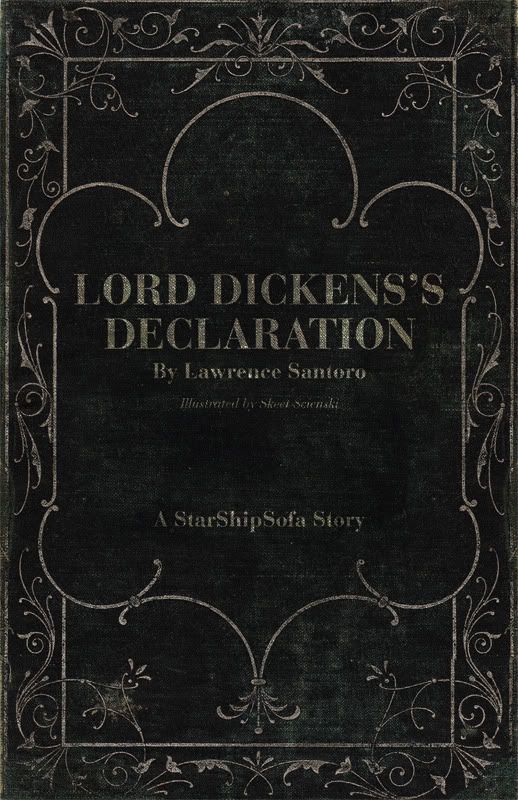
Lord Dickens's Declaration


Novella by Lawrence Santoro

Broken up over three episodes of Starship Sofa, podcast for free as always, and brilliantly read by the author himself. It must be pointed out that Larry Santoro is one of the greatest story narrators of all time. If listening to this doesn't convince you, check out his other voice work.

On first listen, the first third is nearly incomprehensible in parts. At least to the ability to understand what the hell is going on. Maybe I was just tired though.

Santoro's introduction to Part II explains the first part much more clearly than it came across actually listening to it, so I'd advise not skipping it even if you are listening back-to-back-to-back, there is a decent chance you missed something important. That said, it is also worthwhile to actually listen to the first third, it isn't that bad.

The introduction to Part III is less vital, but still nice. Finally, the wrap up bit by Santoro is really fun and interesting to listen to, about how he came up with the ideas of the story and went about building it up.

Now, on with the actual story review.
This is an alternate history, steampunk time travel story. Set in a 1902 without religion, where war is something long forgotten, Jesus was a politician, as were Poe and Dickens. Literary historians are at the top of the academic food chain, with math and science at the bottom, filtering up through the softer and softer humanities. Philby is one such time-traveling literary historian, and this is largely the love story between him and his constant rival: Master Mary Mariah. The interaction between the two of them is pure gold. They fight and betray each other and call each other names, and from the very first segment, where my overall comprehension was lowest, I knew they secretly loved each other. That effect is throughout the story the finest bit of writing by Mr. Santoro.

So Philby gets in trouble for traveling back in time without proper protection, as part of his research into Lord Charles Dickens's declaration of love and proposal of marriage to Queen Elizabeth. He thinks it was not true love, just a ploy to get out of a publishing contract. This opening sends us off on an exceptionally weird, fun, confusing, and at times hilarious alternate history adventure. The ending is oddly sexy, and then oddly philosophical, I like the concluding segment quite a bit.

I don't want to give too much away in plot summary, so I'll just wrap this up with the comment that Santoro's ending and opening segments around the story are a pretty good description. There are a lot of little puns and fun anachronisms throughout. The dialogue is snappy even when it is written in Middle English (William of Occam is a favorite character). The steampunk setting is neat, although even more implausible than steampunk usually is (i.e. very). And the overall themes about love, religion, and human nature are neat, but not as well thought out as they could have been.

This is actually something Santoro mentions in his last segment: It's facile fun with ideas, which is unusual for SF which tends to be overly thought out, while Santoro is a horror writer, and they tend to be more concerned with the moments. He also comments that the story seems rough and unrevised, unpolished. I'd agree with the author on all these counts, he basically points out every problem I might have with the story. And yet I quite like it. SF often isn't as well thought out as people would like to think, and humor certainly has it's place.

I regard this story as primarily humorous, with some deeper thoughts lurking unexplored around the edges. It is good, light fun. The first third is confusing and overly complex and the segment most in need of revision. The second third was the most funny and worked the best overall I thought. The third third is a little more serious and deep, while still being lighthearted, although it could use some trimming here and there. But it is a good story, especially for what it aims to do.

I don't think I'm cutting Santoro any slack for writing on a deadline when I recommend this novella with 3.5 disaccommodated, illusory timelines out of 5.

Oddly, the biggest thing I take away from his explanation at the end, is how hard it is to swear and cuss people out without Gods or the concept of eternal damnation. I would suggest he could use vulgarity though.

Best Quotes:
  • "Few heeded Darwin anyway."
  • "Oh lovely twin-backed beasts."
  • "I am persuaded that Elizabeth, among her many virtues, was not a virgin."
  • "Nothing seems to improve a thing like making it larger."

Saturday, July 10, 2010

What the Dead Men Say

Novella by Philip K. Dick

Originally titled "The Man with the Broken Match", changed to "What the Dead Men Say" by Dick's editor, I'm not sure I really like either title.

Johnny Barefoot is a PR man for recently deceased tycoon Louis Sarapis. The plan is to bring Sarapis back to life by preserving his brain and allowing it to issue public statements and oversee the company for brief intervals every year. This is common procedure in 2075, but Sarapis wants to draw it out as long as possible.

When they're unable to revive Sarapis, his heir and next-of-kin is sent for to take over the company. Kathy has overcome drug addiction, is still a bit crazy, but Johnny finds himself falling in love with her (as predicted by his wife). Johnny must help Kathy run the company, defend it from corporate takeover by St. Cyr (their former attorney, now working for a rival company), come up with press releases for the dead businessman, help failed presidential candidate Alfonse Gam get elected on his second try, and deal with the mysterious transmissions from space that seem to be coming from the brain of Louis Sarapis... despite Sarapis' body being right here on Earth.

And then Johnny's life gets even more weird and complicated. The mystery of Sarapis' voice from space is the driving force of the story, and it's increasing desire to interfere with the election. Eventually we end up with paranoid conspiracies and a section of pretty effective horror writing.

The overall mystery could have been wrapped up a little better, and a few minor plot holes exist, but the story pushes ahead fast enough you hardly notice. Some things I thought were going to be plot holes were actually explained in a surprisingly logically obvious manner, but the ending remains open and I'm unsure whether to assume the lesser or greater evil resolution. Either way, this ends darkly, but I like it.

Not Dick's best work, but pretty good, and I definitely like this more than the only other review I could find did. Johnny has a few different theories through the story, and the best thing about Dick's writing is that I believe each one of them, and then discard them, right along with Johnny. This is his most useful, recurring talent as a writer. 4 out of 5 matchsticks aren't broken; 4 out of 5 PR men have it easier than Johnny Barefoot.

Saturday, June 19, 2010

Vishnu at the Cat Circus

Novella by Ian McDonald

My personal favorite of the 2010 Hugo Award novella nominees.

Vishnu is a bioengineered genius in a future India ravaged by drought and the technological singularity. Now the proprietor and ringmaster of his "Marvelous Magical Magnificent Cat Circus!", he makes a living telling stories and showing off his trained cats.
"All they do is run in a circle? Brother, with cats, that is an achievement. But you're right; running in a circle, nose to tail, is pretty much the meat of my cat circus."

The story he tells within this frame is the bulk of the novella. It is the story of his life, from his parents falling in love while escaping killer robots, to his nearly deadly sibling rivalry with his naturally brilliant brother and both of their rise to the top of business and politics (and Vishnu's implied fall to the bottom). Vishnu's life might be approaching too much detail, but it is pretty interesting, and even more interesting is the background technological advancements and the exploration of an underused cultural background. McDonald's near-future history of India is one of the biggest draws in this novella in particular, and in the Cyberabad Days collection in general. But this is my favorite bit of extrapolation in the collection. Not only does it go a bit farther, it covers some new and unique ideas.

But the best part by far is Vishnu's interspersed bits of present-day storytelling to the hypothetical audience. He is humorous and more interesting in voice than his younger, more naive self, and his talk to the audience is used for meta-commentary to the reader, not only about symbolism, but about story structure and the reality of heroics.

This is a dark series of predictions, but it is fairly funny and extremely interesting. There is lots of recurring water imagery, as well as the metaphor of striking a diamond correctly to split it, or incorrectly and ending up with a pile of shiny, useless dust. But the main theme, to me, is how we forget about and ignore the poor as our march towards progress increases the divide between the haves and have-nots. And how there might not be that much they can do about it, they might just be screwed.

Although the last paragraph doesn't especially impress me, I love the conclusion overall. We aren't sure whether Vishnu will succeed or not, and we certainly don't get his metafictionally-promised big confrontation with a villain capable of a long, drawn-out dramatic death scene. But we have despair, and hope of a partial solution and some great meditation on heros, villains, and resolution. And maybe that is enough. 4.5 feline incarnations out 5.

Friday, June 18, 2010

Palimpsest (Novella)

Novella by Charles Stross

Originally published in Wireless: The Essential Collection

For a Novella, there isn't really enough to this story.

It is a brilliant bit of worldbuilding, especially the ideas behind how the stasis works and how they plan to keep Earth alive for so much longer against the natural lifespan of the galaxy. The time travel mechanism required by the narrative is an interesting and slightly different one and I enjoyed how Stross explored that. The "Brief Alternate History of the Solar System" segments were particularly good.

I do have a few problems with this novella, however. The second person narrative bits at the beginning of most chapters are pointless and annoying. I realize Stross wants to differentiate the possible alternate Pierces from "our" Pierce, but he doesn't really achieve this until the last few times, it remains annoying-as-hell even after we get it, and really how does making alternate versions of a third person narrative into second person make any sense anyway. Use a different font or something, I don't know.

Besides that, I was a bit annoyed by the invocation of Kafka, both as the appearance of the Internal Affairs guy and with a section called "The Trial" in which he appears. There wasn't enough actual reference to Kafka's "The Trial," or any other bit of his writing to justify this. There was bordering on 0 reference to Kafka besides Stross name-dropping him a few times. It annoys me when allusions are made to things like this for no good reason, and not really tied into the writing in any other way. If he wanted to have a guy look like Heinlein, I'd have loved it. Or if he wanted to really reference "The Trial" a lot in that section of this novella I'd have been okay with Kafka. But I don't like the randomness of what could have been a meaningful literary allusion. It seems like it just wants to name drop a bit in hopes of sounding more thoughtful.

Which is too bad, because the story is pretty thoughtful as it is. I love a good time travel story, and this one is intense, suspenseful, and has possibly the grandest scale and best sense of wonder I've ever experienced from a time travel story. But there isn't much more to it. Like I said, this piece oozes Heinlein.

So I'd recommend that anyone who enjoys time travel stories (or Heinlein) even a little bit should read this one. But I can't recommend it as an award nominee. 4 out of 5 paradoxes overwritten.

Tuesday, May 18, 2010

The God Engines


Novella by John Scalzi

It was time to whip the god.
Easily the best opening line on either this year's Nebula or Hugo ballot.

This novella is John Scalzi's first attempt at Fantasy and it's definitely a success. I prefer this to his science fiction books, and rather than "high fantasy", The God Engines is what Scalzi calls "dark fantasy". It's a horror/fantasy hybrid set mostly on a spaceship. Which I suspect is much more to my liking.

Captain Tephe commands the Righteous, a Ship of the Line in the space fleet of a galactic empire level theocracy. The title of the novella is meant literally: rather than some kind of Phlebotinum, the ships and their FTL capability are powered by the enslaved gods of conquered civilizations.

The story opens with the god engine of the Righteous acting up. After disciplining it, they are called back home and assigned a high priority, top-secret mission. This is where the focus moves away from the fantasy worldbuilding to the simmering menace beneath pretty much everything, eventually progressing to all-out horror. The return to the ship after being assigned the mission marks the boundary between mediocre story with an interesting setting and can't-put-it-down, finish-in-one-night horror story with some points to make about trust in your superiors and blind faith in general.

I don't want to reveal specifics, but there are several major world-shifting revelations, all of which are foreshadowed but still surprising. As the whole tone of the story would lead you to believe, the ending is not a happy one. But it is amazing. The last chapter is what makes the story for me and in that sense, despite the length, this novella lives up to Edgar Allen Poe's definition of a short story in that it is all about one big effect (and that I, at least, read this is one sitting, albeit a long one).

That said, surprise and revelation aren't everything, the tone still creates a nice horror effect and The God Engines is equally enjoyable on a second reading.

The theme is really one of the folly of blind faith and how, even still, people cannot let go of it. Definitely some material worth thinking about once you know the whole story of how the world works.

I've seen some criticism of the characterization and perhaps the secondary characters are underdeveloped, but not to the detriment of the story and not any more than is justified given the short length. Tephe and his obnoxious priest rival are quite well drawn, to the point where captain Tephe takes a course of action towards the end of the story that never would have occurred to me, and I find it completely believable for his character. A flat character would have me blaming the author for manipulating things for the sake of plot, but this feels natural.

A note on the physical book: I really like everything about it. The dust jacket art, the page design, the paper and especially the four pieces of internal artwork. Scattered through the book there are four full-page illustrations of key scenes. They are well drawn and look good in the book, they just fit in well. The scenes chosen are good ones to illustrate and three of four are in the first half, where illustration aids in the worldbuilding. I think they are a nice touch and between all these factors, this book has convinced me to buy more things from Subterranean Press in the future.

While I was apprehensive for the first half of the novella, given some clunky dialogue and far too much exposition, things were interesting enough to keep me reading. The later half more than made up for the weakness of the beginning. The menacing sealed-evil-in-a-can feeling of the Righteous's god justified the blurb on the back comparing this to Lovecraft and was impressive in itself. The conclusion went on to top my expectations. 4.5 out of 5 and my favorite for the Nebula novella category.

Sunday, May 16, 2010

Shambling Towards Hiroshima


Novella by James Morrow

This has been reviewed to death elsewhere, due partly to it's Nebula and Hugo nominations, and partly due to being James Morrow. An index of other reviews can be found here.

My only comment in regards to reviews is that people thinking anything can be inappropriate subject matter for satire or humor is just plain wrong. Humor can be done tastelessly, but it can't be inherently off-limits by topic. And James Morrow is not tasteless. Actually his handling of the sensitive issues here is quite delicate.

Syms Thorley is a B-Movie actor during WWII. The Navy hires him to help demonstrate their giant, fire-breathing lizard project by dressing up in a lizard suit.

Many reviewers remarked on the change in tone at the end of the novella. This is really the difference in tone/theme between the historical memoir and the framing device. Towards the last 1/5 or so, the memoir wraps up and what was initially the framing device becomes the entire story. The memoir is the bad horror movie/military weapons project satire that the book is generally described as, while the framing is established with the opening sentence:
"Whether this memoir will turn out to be the world's longest suicide note, or instead the means by which I might elude the abyss, only time can tell...".

So this darker suicide central story is sprinkled throughout, and we learn what happens with the war effort long before we learn what I see as the central question: whether Syms will kill himself or not. And on this front the book particularly impresses me. I was genuinely surprised several times in what I expected to be a very predictable substory. And perhaps the most tragic moment in the entire book made me laugh. And then feel bad about it, but it was funny, dammit. That is the real pleasure of this book. Essentially it is a book about suicide and about how nuclear weapons are both horrible and stupid. And it makes its points while being one of the funniest things I've read in some time. Not Douglas-Adams-style absurdity, more Vonnegut-sarcasm. And I use Vonnegut not only because it seems apt in the style sense, but because Mr. Morrow mentions on his website that he loves/hates that comparison: unlike Vonnegut, Morrow actually likes people.

Overall, a very funny novella, but one where you need to think, not just to get the jokes, but to get through the serious points. You don't need to know anything about B-movies, 1940s actors/producers/directors/screenwriters, the Manhattan Project, WWII, Edgar Allan Poe, Ray Bradbury, or comic/SF conventions, but they all add to the experience. Well a passing knowledge of Poe and WWII and monster movies may actually be required. But not too much is needed.

4.5 out of 5 actors don't realize how easy it would be to pick up chicks in a giant lizard suit.

Saturday, May 15, 2010

Arkfall


Novella by Carolyn Ives Gilman

Humans have colonized the under-ice ocean of a far away planet. The society that has developed in this colony is based on passive-aggression, as one character puts it. Social cues are everything and you rarely address anyone directly. I'd go nuts living there, but it is interesting.

Osaji is unhappy with her lack of self-determination or any kind of freedom and feels tied down by here Alzheimer's afflicted grandmother, and unable to escape because of the guilt. This is a fairly quiet story of interpersonal relations with a decent amount of sense-of-wonder, and I can't get into much detail without spoiling it, but not much detail is needed. She gets lost in unknown territory with a far from optimal set of companions. They discover some things, but more importantly learn a nice little lesson about the sweet spot between selfishness and selflessness.

I was disappointed by the ending: I quite liked the solution to the problem, but didn't like how patly things ended up. It made some of the beginning feel a bit pointless. On the other hand, I enjoyed seeing the change in Osaji, how she found a sense of adventure and became less entangled in her culture's counter-productive shortsightedness. I'm not saying the resolution should have been different in outcome, just that I'd have liked a little less of the human cost waved away by the author at the last minute.

The story was okay, the setting and the ship were damn cool. The Bennite idioms amused me. One might rate a story 3.5 out of 5.

Friday, May 14, 2010

Sublimation Angels

Novella by Jason Sanford

The opening of this novella feels awkward and overwrought.
Across the vacuum black, countless Aurals shifted the star field into a mnemonic ROY G. BIV of circles and exclamations.
But after the couple pages, the next 30 or so are a vast improvement. Like some other stories, the opening set me up to pick it apart. I wasn't quite making a list of problems but I was close. So it should say something that by the end, I was loving it and completely caught up in the world. 3.5 out of 5.

The setting is inspired by Fritz Leiber's A Pail of Air (text online here) although we are in a maybe post-singularity existence, ruled by AIs who can control our minds. In what may be an effort to save/help humanity or may be just random meddling, a species of even more powerful energy beings (Aurals) have set up an area of space where they will destroy any high technology. As a precondition to communicate, they require the human/AI civilization to put settlers on a planet with a frozen atmosphere with little technology. An AI is sent along inside a human body built for her.

This is the root of my other main problem of the story: the police state Big Mom presides over seems unsustainable in the long run (600 years). The execution or covered-up murder of anyone who questions the obviously untrue or says the wrong thing at the wrong time certainly happens, but in a small population living under such harsh conditions that they melt air to survive and can only grow a very few crops around a giant compost tank, it just seems like these sort of policies could quickly lead to extinction. Especially since a lot of the lower job are already very dangerous and many people seem to die unmurdered at a fairly young age. They had better be slightly more fertile than rabbits in a society like this. But on top of that, the overly cruel head guard who is willing to torture people to death for basically looking at him funny (admittedly, he is the eventual cause for revolt) and the willingness the guards have at the beginning to murder a couple of 10 year olds for asking an obvious question, whose answer has absolutely no downside for the administration, and hell, even the presence of three armed guards ready to kill children in a threat-free (at least any threat their weapons could do anything against) coming-of-age ceremony, all of this just seems profoundly stupid cruelty-for-the-sake-of-cruelty. Especially considering a revelation about halfway through the story, I would think she'd want to keep people a little less miserable.

So besides that, and the willingness to ignore or threaten to kill the chosen one (our protagonist's brother) who would presumably be the one chance to fulfill the whole damn mission, I do think a point is being made about the tendency toward totalitarianism and unfair/unnecessary cruelty or something. But it almost feels silly it is so over-the-top. If this is how the AIs behave, I really do feel sorry for humanity. Still, after a while, the characterization and writing are good enough that you become completely caught up in the world and can ignore all this and just hate the bad guys.

These flaws are perhaps overemphasized in this review, as the pdf I have is 32 full size pages long, and my problems with the story gradually fade away. I was loving this for at least the last half, maybe even the last two thirds. I quite liked this story. The classic rebellion from authority theme, the change in our protagonists by the end of the novella, and the fact that after being manipulated by everyone for his whole life, he is finally able to see through things and do some manipulating of his own. And the setting is absolutely brilliant. As I said, based on A Pail of Air, but I might even like this one better, as a setting. Both the background dealings of the AIs and the Aurals and stratified society in a harsh fallout-shelter-like environment really struck me as fun, interesting, and original, even if heavily inspired by pre-existing fiction.

Thursday, March 11, 2010

Kiosk


Novella by Bruce Sterling
Originally published in F&SF (Jan 2007)

Borislav runs a little kiosk, selling all sorts of random items. He is finely in tune with the local economy and what hot new items people want to buy. Then he acquires a fabrikator, a medical-quality 3-d printer. Soon various outsiders, politicians, EU bureaucrats, and professors get involved and things get out of control. The economy is radically changed, leading to an armed revolution with Borislav at the center.

As an idea story, this is excellent. It examines the 3-d printer concept from an economic and social perspective much deeper than many such stories, and the poor, second world country setting is an important and underused viewpoint. The EU and more developed countries want to keep these things under control, but the people who just want to be able to afford knives and hair pins have a much different view of copyright. The revolution is dealt with quickly, all the focus is wisely saved for the causes and repercussions.

Borislav is an interesting character, and we get to know him pretty well, since the first half is spent listening to him philosophize on economics and social trends. And here is the best thing about Bruce Sterling: I was never bored by this. The dialogue is witty, the setting is very well developed by the random people Borislav interacts with and his discussions with them. He remains lightly sarcastic through the revolution to become the king of the prison economy when he is arrested afterward. And yet he's an idiot with the ladies.

So I love the setting, the idea, the character, the dialogue. Why am I going to give this less than a perfect score? Well the plot doesn't really do much, but I never lost interest and that wasn't the point; I'm fine with that. It was something that rarely bugs me enough to actually remove points: style.

And it frustrates me, because I can't pinpoint my exact problem with it. It is a bit dull and understated and utilitarian I suppose. More pessimistic than I'd like. But those really fit the setting and the character, and there is humor to be had. And to some extent, that is just how Sterling writes, and I've enjoyed his writing quite a lot in the past. Maybe it is the philosophy after all. I was interested in it, I wanted to keep reading, but maybe it distracted me, or wore down my enjoyment of the story. But I love Neal Stephenson, and he lately writes 900 page books with nonfiction essays chucked in. So I'm not really sure what it was, but I had no connection, no emotion. I didn't really care. I wanted to read the economic philosophy and think about nanotube printers. These desires were fulfilled, but I'm unsatisfied. So here is my best guess: Sterling did an excellent job of laying the hook and promising exactly what he was going to deliver, but it turns out that wasn't what I really wanted from a novella of this length. Maybe if it were shorter. Anyway, I'll close with a quote:

Some dedicated groups of damned fools would have to actually carry out the campaign on the ground. Out of any 10 people willing to do this, 7 were idiots. These seven were dreamers, rebels by nature, unfit to run so much as a lemonade stand. 1 out of the 10 would be capable and serious, another would be genuinely dangerous, a true immoral fanatic. The last would be the traitor to the group, the police agent, the coward, the informant. There were 30 people actively involved in the conspiracy, which naturally meant 21 idiots.

And 4 out of 5 enjoy Bruce Sterling.

Monday, February 22, 2010

Ghosts Doing the Orange Dance


Novella by Paul Park

I've read this story three times now, and I've taken pages upon pages of notes that look like the scribbles of a crazy person. And I can only partially attribute that comment to my handwriting. I love this story, I want to make all of my more literary friends read it (at knifepoint if necessary), and yet I can't summarize it in any remotely concise way without ruining it. And half of the people who have read it seem to give up 1/3 of the way through. But maybe I shouldn't be surprised. My inclination wasn't so much to force it on the Heinlein/Tolkein enthusiasts (NotThatThere'sAnythingWrongWithThat), but more the Umberto Eco/Philip K. Dick lovers, and the Faulkner/Joyce crowd if I was serious about that knife. Although I'm worrying about hyperbole here, I think this novella was brilliant, but it won't appeal to everyone.

This is a funny, autobiographical (more-or-less), deeply reflective, convoluted, complex, confusing, ingenious story about how we make our lives into stories; and then the stories we tell ourselves get out of control and structure invents content. We lose track of the real facts, believe things that on closer examination can't be true, and make up nonsense explanation to explain the little bits of life that make no damn sense. And this is all explained in the second of nine segments.

Park, the self-character of the author proceeds to fly off on tangents about how he has trouble staying on topic, debate the merits of foreshadowing in this weird little combination of memoir and science fiction story he is writing, tell bold-faced lies to the readers that he admits to a few pages later, and piece together bits of writing from his relatives into a hereditary obligation to help protect society from otherworldly forces, maybe.

Like I said, I can't do this thing justice. But what stands out to me are the well done self-referential comedy, the great scenery descriptions, and the countless recurring little tidbits that pull his life, and his ancestors' lives together into a bizarrely complex whole, many of which are probably misremembered or imagined. The downside is that two excerpts of ancestral documents in particular were quite a slog, especially the first time through when I had no idea what to look for, and that while the ending was good, the last line itself was lackluster. But I don't know how it could have been much improved, and on reflection the whole thing was great.

I misremember this story as a 5 out of 5, but it was probably more of a 4.5 in reality, if only because of the ending. But keep in mind, my hyperbole-tastic comparison is Umberto Eco, so no whining about having to think.

Tuesday, January 19, 2010

Earth II

Novella by Stephen Baxter

Nothing to do with the tv show, for better or for worse; nothing to do with comic books, for the better.

I am not a fan of names so very generic, especially when it seems only there for lack of a better title. But the generic title doesn't ruin the rather good story.

Xaia Windru is a warrior queen sailing around Earth II and exploring things, her husband is a stay-at-home-king involved with the politics of building a super-library. The exploration of Earth II is exciting, and there are some good ideas here, but the top library lobbyist strikes me as a Hari Seldon wannabe. The discoveries Xaia makes on her expedition are surprisingly relevant, but are always revealed back home by one scholar or another at the same time. This gets a bit annoying.

Regardless, this is a strong adventure story with some really interesting concepts, particularly the organism known as The Purple. And, following up the return of our heroic/dangerously impulsive warrior queen is a conclusion that really surprises. I don't agree with the end at all, and if I lived in Zeeland I'd probably commit some sort of treason, but it is perfectly in character and makes logical sense, I just hate it. And that is what makes it, I can't stand the ending, but I have no problem believing it, and get angry enough that I might as well be there. So well done Stephen Baxter, 4 out of 5.

Monday, January 11, 2010

Act One

Novella by Nancy Kress

This has now been nominated for both the Nebula and Hugo. I went back to see why I didn't like it, because I couldn't remember anything besides there being a dwarf and some genetic terrorists. On second thought, that is reason enough for it not to win awards.

This one is going to join Gunfight on Farside as a good story that I liked, but not nearly as much as internet/reviewer/best-of-collection-editor consensus indicates I should. 3 out of 5.

The strange thing is I can't really identify why. The protagonist, Barry, is an excellent, well drawn character. Imagine Toby Zeigler washing out of politics and deciding to become an actress's manager. Also he's a dwarf and has to think about genetic modifications and free will.

I love this sort of character, I love genetics, the ethical issues brought up by the story are important,
every character is excellent, the plot is plausible yet surprising. The only complaint I can come up with is that the ending is maybe wrapped up a bit too fast, but I see no good way to make it longer, and it does make you think. There is really nothing wrong here, but I didn't love it, I only liked it. Kress is an excellent writer, and you can certainly see that in this story, yet it lacks the punch it ought to have for me.

Broken Windchimes

Novella by Kristine Kathryn Rusch

The Pané are a species of aliens with extremely picky musical taste. Picky to the point I can see it being selective pressure against the continued existence of their society, but everything works so well I can get past it. One of the top musicians on the planet, a castrato male soprano, misses a single note during a performance, and his career is over. So rather than sit around being a has-been he catches the first cargo ship to the musical capital of human space. There he spends a bit too much time agonizing over the specifics of musical theory behind the blues, before getting to an extremely poignant conclusion. This one brought a tear to my eye, and proves that Ms. Rusch does actually know how to write a brilliant ending when she tries. 4.5 out of 5 orphans can sing the blues, but they don't all have perfect pitch.

Sunday, January 10, 2010

The Sea of Dreams

Novella by William Barton

A jumbled mess, with a couple good ideas tossed in at the end; 1 out of 5.

At 38 pages, I found exactly one page of this novella good, with maybe another ten worth reading to get to that one. And that leaves a good deal of fluff. You could safely amputate the first 25 pages without losing much of anything (the mark of great literature!) The Sea of Dreams should have been a short story, and even then I can't see myself giving it more than maybe a 2.5 out of 5 with extreme editing.

There are many instances of entirely irrelevant sex in this story. And for all the time wasted talking about sex, it is neither graphic nor erotic, so you can't justify it as erotic fiction either, (if you consider that a justification). The central scientific dilemma, while admittedly not the point (although I'm not sure what the point was) is complete rubbish. The problem the characters have to solve would have resolved the same with a comatose protagonist being wheeled around between scenes, although I guess his boring chatter ended up making things worse for some parallel universes we don't care about.

A brief plot summary (spoiler-light, although I anti-recommend wasting your time on this) :
7 pages of almost entirely irrelevant introduction. 12 more of dealing with a civilization that exists purely as an homage to Edgar Rice Burroughs, with some Red Orm references sprinkled in. Neither of these have any bearing on anything. I quit reading 6 times during this part. It took me a week.

Finally, we get to the good bit: 9 pages of moving between some other irrelevant locations, with about a page worth of disjointed, barely comprehensible useful background, delivered with lots of made-up terms that never matter. Then our pointless heroes get sent to the past for 4 pages of standard-issue paradox avoidance, before being sent to the distant future for 5 pages of wandering around aimlessly with a little bit of pseudo-physics thrown in.


And finally the quest to return home is completed with a very literal bit of deus ex machina and we get exactly 1 page of fairly thought provoking denouement, although it ends with an out-of-nowhere speculation about which option to choose of what seems to me a false dichotomy about an issue I'd gotten the impression the protagonist should have moved past long ago. Why the hell semi-ruin the universe to get back a lost love after spending the whole novella falling for your cloned sex slave. Not that the reader can actually care about our central lizardman anyway. 38 pages and all the character development of 5. The saving grace to the ending was that it wasn't either terrible thing I expected: it was neither all a dream nor The Number of the Beast for dummies. Small victories.

Tuesday, January 5, 2010

Pelago

Novella by Judith Berman

Ari's parents have been killed by space pirates in a very creative future setting.  She joins their crew hoping for revenge, but first has to prove herself useful.  An ancient space station that responds to her commands gives her some interesting options here, if only she can pull herself together psychologically enough to survive.  Space-Opera/Horror/Coming-of-Age.

This novella is actually an excerpt from Berman's novel-in-progress Invisible House.  But don't let that put you off.  It had me worried a bit too, and it did take a little while to piece together all the background information, but everything you need is there.  And more importantly, there is an excellent ending to this excerpt.  A lot of novel excerpts end on a "to be continued... buy my book!", but this concludes very nicely.  Only the immediate situation is resolved, and there is clearly more story in store for our heroine, but I feel confidently optimistic about her future.  Ari develops impressively over the course of this segment and the ending surprised me by being better than my at-the-time ideal way to end the story disregarding continuing it as a novel.  

Additionally, this story evokes some real fear and manages to paint the pirates both as terrible monsters, and as realistic, round characters.  At novel length I can imagine myself cheering for the captain who had one of his crew turned into a still living, sentient chair.    Ari is a great protagonist with much more depth than usual to the revenge motive, and heck, I'd even read a story about the poor repairman who was stranded on the station before this excerpt starts.  I'll definitely be reading the book when it comes out whatever direction it takes, my only worry is that I might like this segment better than the novel considered as a whole.  5 out of 5.

P.S. The pirates speak in a grammatically bizarre creole dialect that some people find really annoying.  I was a bit frustrated at first, but you can learn to parse it fine after a while, and it is definitely worth the effort.  Much like Juliette Wade's Cold Words, the non-standard speech is justified by the story, and, although it may be frustrating to the reader, doesn't provide that much of an obstacle, and succeeds in enhancing one's enjoyment of the story.  Don't let early frustration prevent you from continuing on.