Wednesday, January 19, 2011

Sir Hereward and Mr. Fitz Go to War Again

Novelette by Garth Nix

A youngish-but-experienced knight/artillerist and his animated wooden puppet advisor travel a fantasy land looking for mercenary work. When they find a likely city, Hereward manages to offend an attractive-but-scarred officer and love interest and fight a duel with her. Then the duo discover something about the city they are visiting, forcing them to act in their secret, non-mercenary roles. This brings him into conflict with aforementioned potential love interest.

An extremely fun and exciting bit of fantasy, if a bit long. This brings a lot of the older fantasy short stories to mind, with hints of Fafhrd and the Gray Mouser, and maybe even a touch of Conan (Howard's sneaky, magic-fighting version, not the Governator). There is definitely more here than meets the eye, and while I'm not generally in love with series', I am looking forward to some more stories here. I like how much of the history is left implied, and although I did think leaving all the major revelations until the end was a bit off-putting, the fact that they were there shows some excellent world building and makes the whole thing more immersive into a very interesting fantasy land. A bit slow to start off, and a bit heavy on the big game-changing reveals toward the end, but this was an excellent work of fantasy, and didn't go the predictable, expected, pat ending I'd expected from a sword and sorcery work. Which I suppose is why I'm reminded of the old guys. I remember why I used to like this genre. 4 sorcerous puppets out of 5.

The reading could have been better, as a few words were pronounced oddly, but Mr. Tevis doesn't have a bad voice.

2007 Winner of the Aurealis Award for Best Fantasy Short Story
Anthologized in:

The Whistling Room

1910 Short Story by William Hope Hodgson

One of Hodgson's Carnacki the Ghost-Finder stories, a sort of supernatural answer to Sherlock Holmes. Some of Carnacki's cases have mundane solutions, and some supernatural, so you're left unsure of things until near the end, thereby avoiding the Scooby-Doo/Dresdan Files failure of always falling on one side or the other.

Basically a guy buys a (maybe) haunted castle, makes several bets that he'll stay there for a number of months, and then hires Carnacki to figure out if it really is haunted. Obviously anyone he made a bet with has motive to try faking him out, but the reputation is pre-existing.

I enjoy the Sherlock Holmes feel: the story is told by Carnacki after he has half-finished his investigation, to his friends over dinner in his flat. One of these friends then relates the story to us. The whole thing is full of references to previous adventures, and I suspect some of those references were never written, in the style of Arthur Conan Doyle's fictional self-references (I haven't read all the Carnacki stories, so I can't be sure, but I definitely get that impression).

As to this story in particular, the pace moves along rapidly, and I'm really in edge-of-my-seat territory towards the end, despite the 1910-style prose. The characters are pretty flat, and there is no metaphor or subtlety, but the whole thing is still a good, fun read, and it is just a really strange (and therefore interesting) story, both in the actual solution to the case and in the techniques Carnacki uses and off-handedly references during the course of his investigation.

The climax could be read as a bit of deus-ex-machina, but essentially Carnacki still has to take action, he is only given an opening to do so, and it doesn't absolutely resolve everything, so I'm a bit more okay with it. I also like the implications of much grander things implied here, in a pre-Lovecraft Lovecraftian fashion.

A very strange story, not the best written (and I feel I can expect more from Hodgson given books like The House on the Borderland), but I really like the style and this is fun just for some of the bizarre pseudoscience used in the investigation. 3 numbered wafers out of 5.

P.S. This is available free online here, and in plenty of other places, since it is public domain.

Monstrous Embrace

Short Story by Rachel Swirsky
Read for PodCastle by Elizabeth Green Musselman

The Anthropomorphic Personification of Ugliness wants to marry a prince who used to be ugly but isn't anymore. And also save the kingdom and maybe defeat a greater evil. Overwritten, second person future-tense used much less effectively here than in A Memory of Wind. It was neat in that story, but the novelty alone doesn't do anything for me. It seemed appropriate and useful to the story there more than it does here. I worry that Swirsky may fall into this as a characteristic style, which could undercut my enjoyment of her in general. Not that it is always bad, but it has a time and a place.

The concept of Ugliness as a character is a weird one. On the one hand, I don't think I've ever seen it before. On the other hand, this means that everything in the world is categorized by whether it is ugly or not. If you like swamps or prefer rock over grass or a million other ways where beauty can be subjective, it breaks some weird holes in the premise. Enough that it didn't make enough sense and sort of bothered me.

While it is interesting that magic is derived from experiences, I'm not clear why the king matters to the magic system here. Swirsky is implying an extremely powerful divine right to rule without explanation for said power. It also seems weirdly inconsistent about how powerful Ugliness actually is. And why, with an eternal, infinite concept, is this the story where she chooses to make a stand? Because this king was ugly once? There are a lot of ugly people, and I'm sure beautiful witches aren't unique in the entirety of time either. So I don't get why this is so one-time-special.

Swirsky wants to say some nice things about judging based on appearance and all that, but these observations are old hat and she undermines herself with the description of Ugliness anyway, and then gets a bit heavy-handed with the theme anyway. On top of that, nothing makes much logical sense. Finally, the writing seems over the top in parts, and quite literally put me to sleep. Overcomplicated backstory for everyone reveals a complex world, with elves, but not enough to save the story. I do like the bird though.

2 beautiful marshlands out of 5.

Originally Published in Subterranean: Tales of Dark Fantasy

Skatouioannis

Short Story by Nick Mamatas
Read for Podcastle by David O. Englestad

The son of Greek immigrant parents has been told stories of Skatouioannis, the smelly boogeyman/ancestral spirit, since he was a child. But when he wants to leave home and his parents and move out into the world, it starts manifesting itself and actually holding him back.

Both a series of scatological coincidences that conspire to keep our hero at home, an angry, smelly old man with a donkey cart and a shovel, and a metaphor for how the old ways can conflict with technology and science and try to keep anything from changing, Skatouioannis is a great invention.

This is a modern spirit/demon story with nanotech, New Jersey, and hippie-girl romance. It's hilarious throughout with a more serious confrontation towards the end, a good central metaphor, and some musing on modernity versus tradition. But where tradition is backed up by actual (if smelly) magic. I like this one a lot.

4 shit-spirits out of 5.

The Mermaids’ Tea Party

Novelette by Samantha Henderson.
Read for PodCastle by Tina Connolly
Originally in Helix, free online

Cassandra is a little girl, the only survivor of a shipwreck. Rescued by sinister, bored mermaids who put her on an island with a pirate, at their mercy for food. She doesn't know whether she can trust the pirate, but she is absolutely sure she can't trust the mermaids. They want her to help them throw a tea party. And if they get bored, they're likely to kill her.

A coming-of-age story about a girl disappointed in the lack of fantastic creatures, who gets something much less Disney than what she might she might have hoped. Also the story of how rich men can be terrible people, and pirates might not be so bad. The ending is semi-ambiguous, but it is pretty clear what Cassandra is going to do. It's a straightforward story, unsurprising once you get the setting and all the pieces into place, but still suspenseful.

The writing and narration are excellent, the characters well-drawn, particularly Jack the Pirate, who has been stranded too long, gone a bit crazy, and only barely hanging on to his morality, but nonetheless hanging on, despite stress and loneliness, where other men (like Cassandra's father) are likely to fail. And Connolly's reading is great, particularly the accents. It lends the right tone to the darker scenes that really build the characters and the tense humor of the tea party itself, my favorite scene involving mermaids that I've ever read.
3.5 fishy bitches out of 5.

Smokestacks Like the Arms of Gods

Short Story by Ben Burgis
PodCastle's First Ever Original Story! Read by Ben Phillips

In a fantasy world where one big corporation owns everything, maintains an army, fights wars against goblins, and keeps its Irish-American-named workers from revolting by employing vampire security guards, a few steel workers organize a labor union.

Ben Philips does another great job of narrating in this one, and it somehow avoids the feeling of being too obviously just real life with generic fantasy elements added to it. Which was the most obnoxious thing about Narrative of a Beast's Life. While this is just labor unions with magic and vampires and goblins, the world building leaves a bit more unsaid, and by implication gives a grander scale to things.

The steel workers are taken seriously enough that the whole thing doesn't come off as hackneyed as it might have had the vampires been used for parody. This is a serious tale, not a Pratchett or Pratt wannabe. Which is good, because I frankly don't think Burgis could compete in that arena. My main criticism is that the whole thing was a bit obvious, and particularly, while I liked the very ending, it was easy to see coming as soon you knew what was going to happen to the guys. It was a great, but obvious, ending to a good, but obvious, story. The best part of the story was probably the goblin war, but that was all tangential to the tale being told, and was rightly kept to a minimum.

Still a good story with some nice imagery to live up to the title, and a great ending. 3.5 out of 5 steel factory foremen have green blood running through their veins.

Friday, December 10, 2010

Science News with J.J. Campanella 2010

A summary of J.J. Campanella's Science News articles in Starship Sofa for the year 2010.

#114, 12/23/09, Rating: A: Contagious Emotions, Caterpillar-Ant Trickery, Tumor Suppressors, Ebay Shrimp Naming, Marijuana as Addiction Cure.

#118, 1/26/10, Rating: A: Tasmanian Devil Facial Tumor Disease, Sea Urchin Sight, Environmental Causes of Lupus Evidence, Whiskey Hangovers.

#122, 2/23/10, Rating: B: Dinosaur Coloring, Sea Slug Photosynthesis, Cigarette Bacteria, Prion Function.

#125, 3/17/10, Rating: K:

Looking Back at Genre History with Amy H. Sturgis 2010

A summary of Amy H. Sturgis' Genre History articles in Starship Sofa for the year 2010.

#112, 12/9/09, Rating: C: Captain Nemo, 20,000 Leagues, and The Mysterious Island.
#115, 1/5/10, Rating: B: Anthony Trollope and a discussion of his 1882 novel The Fixed Period.
#120, 2/9/10, Rating: A: Ishmael, an unusual 1985 Star Trek novel by Barbara Hambly.
#123, 3/3/10, Rating: A+: Margaret Cavendish, 17th century poet, scientist, and SF writer.

Film Talk with Rod Barnett 2010

A summary of Rod Barnett's Film Talk articles in Starship Sofa for the year 2010.

#113, 12/15/09, Rating: A: Negative review of The Box, discussion of Richard Kelly's other films.
#116, 1/12/10, Rating: B: Semi-positive review of Avatar.
#122, 2/23/10, Rating: B: Daybreakers and Book of Eli, both somewhat positively reviewed.
#126, 3/23/10, Rating: K:

Explained in 60 Seconds with Megan Argo 2010

A summary of Megan Argo's Explained in 60 Seconds pieces for Starship Sofa in the year 2010.

#118, 1/26/10, Rating: C: Red Dwarf Stars.
#123, 3/3/10, Rating: D: Black Holes and Escape Velocity.

Thursday, December 2, 2010

Starship Sofa February 2010


Episode #119: Old School vs. New School
Editorial: Some new ideas for the podcast; interview style: interrogation
SF News from Tony: Kage Baker's Death, Sir Terry Pratchett's assisted suicide test case.
Interrogation of Lucius Shepard
I don't like this interview format at all. I love Lucius Shepard as a writer, and his answers aren't bad or particularly dull, but Tony doesn't engage with him on topics like going to Somalia or his abusive father, just moves on to the next pre-determined, and rather dull, question. Rating: D
Knotwork by Nina Kiriki Hoffman (New School) 4/5

Episode #120: Gene Wolfe
Editorial: Tony gives a sweet, Valentine's Day tribute to his wife.
SF News: Independent book publishers and movement to DRM-free books from Night Shade, Neil Gaiman to write Doctor Who episode(!!!!), death of William Tenn
Promo: Beware The Hairy Mango - Matthew Sanborn Smith's hilarious podcast
Looking Back at SF (and Western) History by Amy H. Sturgis
Ishmael by Barbara Hambly (1985) is regarded as one of the best of the early Star Trek novels, and also one of the weirdest. Most of the action takes place in the alternate history Seattle of the 1968-1970 TV series Here Come the Brides, itself an unusual Western inspired by the story of the Mercer Girls. This bizarre cross-over novel also cameos Han Solo, the Second and Fourth Doctors, Starbuck and Apollo, Emperor Norton, Paladin, and characters from Gunsmoke, Rawhide, and Bonanza, among others. Here Come the Brides, and Star Trek aired around the same time, and Hambly explains in this book why Sarek and Aaron Stempel (both played by Mark Lenard) look alike. So there is an amazing amount of crossoverness and complexity, and apparently the whole thing is semi-canon. I'm very glad to have Sturgis not only pointing out this book, but explaining all the complexity and references in it, and a brief look at how it paved the way for novels such as Shatnerquake! Rating: A
Pulp Cover by Gene Wolfe 4/5

Episode #121: Paolo Bacigalupi
Guest Editorial by Amy H. Sturgis: Hugos and Podcasts
A history of the Hugo awards and electronic and audio media eligibility.
The Gambler by Paolo Bacigalupi 4.5/5
A Hugo for Starship Sofa by Matt Sanborn Smith:
An argument for why you ought to vote for Starship Sofa for Best Fanzine in the Hugos, basically transcribed on his blog. It worked!

Episode #122: Massive 3-hour Michael F. Flynn Episode
Guest Editorial by Lawrence Santoro: The Hugo's
Long-winded audio expansion of the linked blog post. Santoro talks about his geeky 3rd grade teacher who got him interested in SF, the Futurians, and the feeling of community surrounding Starship Sofa. He rambles on a bit, but it's interesting and certainly a worthwhile editorial, more interesting but less persuasive than Matt Sanborn Smith's argument last issue. On one hand, 18 minutes is too long, on the other hand, it doesn't seem like 18 minutes.
The Transcribe Project by Will Reese
Tony interviews Will Reese of the Transcribe Project in a pub in England. Will is amusing in his tales of procrastination (and the number of drinks he orders), but, again, not really entertaining or informative enough to justify 17 minutes listening time.
Science News by J.J. Campanella
An amusing introduction about Jim's children and their obsession with Dinosaur Train leads into a neat article about melanosomes being recovered from fossils which indicate dinosaurs likely had patches and stripes in white, black, red, brown, yellow and orange and may have been closer to birds in their coloring rather than lizards. It turns out the reason scientists often color dinosaurs in drab colors is that they had no evidence and didn't want to make any embarrassing assumptions, so they chose drab lizard colors.
Next up is an AWESOME article about sea slugs who have been able to steal chloroplasts from algae and keep the chloroplasts alive inside their own cells. These sea slugs are now able to create their own chlorophyll and have working photosynthesis, the first animal we've found to do so.
Another new paper suggests that bacteria on cigarettes, specifically in the tobacco itself, can actual survive in smoke to cause lung infections when inhaled. Hundreds of species of bacteria, many potentially infectious in humans, have been identified in a testing of common cigarette brands.
Finally, in a Kuru study, evidence has suggested a new potential function for the protein that mutates into the infectious prions causing it. This protein may be involved in signaling Schwann cells to produce myelin, and if it is, it could throw a wrench in some types of Mad Cow Disease research.
Nothing boring here, and the sea slug piece was great, but at only 3 minutes out of a 19 minute segment, with too much time spent on prion semi-news and dinosaurs, I just don't think this was as good as some of Campanella's other editions. Rating: B
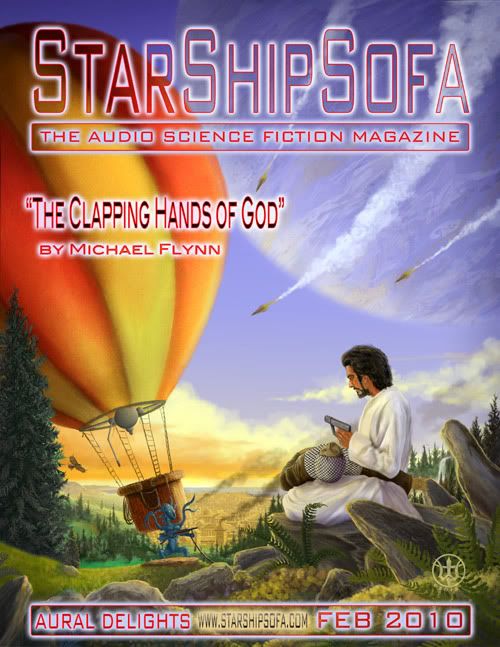
The Clapping Hands Of God by Michael F. Flynn 4/5
Film Talk by Rod Barnett - Daybreakers & The Book of Eli
Commentary on the fact that interesting films are often released in Jan/Feb because studios don't want to release anything that makes money then, and by that they mean big budget crap.
Daybreakers is a post-apocalyptic science fiction vampire film with an excellent cast, and decent effects considering its low budget. Although it isn't a great movie or a classic or anything, Barnett gives it a reservedly positive review because it doesn't romanticize vampires, has a touch of humor, and addresses issues like over-population and depletion of resources. Despite reading a few negative reviews elsewhere, I'm inclined to see this one just for the novelty.
The Book of Eli is about a post-apocalyptic wanderer protecting one of the last copies of The Bible after most copies were burned following whatever wiped out civilization. Barnett likes the treatment of religion and faith in what might have otherwise been a standard action movie.
We're a little light on substance this time, but I'm glad he brought Daybreakers to my attention, and it's interesting to hear about the ideas involved there. The Book of Eli review was pretty slim though. Rating: B

Tuesday, November 30, 2010

The Clapping Hands of God


Novelette by Michael F. Flynn
Read for Starship Sofa by Mike Boris
2005 Hugo Nominee

Hassan leads a team of explorers through a gate onto another world. He is a devout Muslim, in charge of an international exploration/science team with a near-future level of technology. They don't really understand how the gates work, but they open semi-randomly onto many populated worlds. Basically they've developed an international Stargate program.

They set up camp on a mountaintop to study the indigenous people, following a prime-directive-like philosophy of non-interference. They observe the mid-19th century-level aliens with stealth drones and microcameras. One day, the aliens' behavior changes suddenly, and Hassan is forced to wonder if they've been discovered, and how long they can afford to stay. It turns out he has a much more difficult decisions to make.

As someone mentioned elsewhere, it seems Hassan is a science fiction reader, as he encounters and avoids all the standard first contact pitfalls and idiot plots. Throughout the novelette, he reminds his team that the aliens are not human, and we can't ascribe human traits to them or jump to conclusions based on imagined narratives with scant evidence. All the team members are well drawn and interestingly differentiated, and Mike Boris provides different accents and voices for each of them. I was quite impressed with his talent for accents here.

Just as we think the story is going to wrap up in an expected way, the entire situation changes for the more complex. And just when that situation is about to wrap up, it doesn't go how we expect either. The last quarter of this story is excellent, some of the best first-contact storytelling I've ever seen. The whole thing reads like a deconstruction of the standard first-contact tale. The ending is sad, thoughtful, and pragmatic.

4 hands clapping out of 5.

Originally published in Analog, July/August 2004
Anthologized in Dozois' Year's Best Science Fiction 22

Monday, November 29, 2010

Pulp Cover

Short Story by Gene Wolfe
Starship Sofa podcast read by Mike Boris

This story, as explained by the title and at the end, are basically a look at one of the tropes of bad movies and generic cover art of 1950s SF, but with the introduction of Wolfe's subtlety and restraint. A man wants to marry his boss's young daughter, but loses to a handsome, rich, Yale-graduate competitor. Except maybe the guy isn't who he says he is.

This isn't Wolfe's deepest work, but there is still much more to it than your average story. Fear and sadness are much more prevalent than the jealousy you'd expect this story to be about. Somewhat simplistic, there is still an extra twist-beyond-the-twist, and the brevity and openendedness make for an effective horror story. I'm particularly left wondering why the protagonist hired a writer to tell his story (Gene Wolfe, of course!) and why he felt his name had to be hidden, but the world made aware. There is a remaining menace and mystery to what ought to be a bittersweet happy ending, and I really like that.

Primarily a creepy little horror story set in either the 50s or today, but where all the horror is implied, aside from the protagonist's feeling of being generally creeped out. The ending was great, 4 distressed women in tinfoil bikinis out of 5.

Pulp Cover was originally published in Asimov's March 2004.
It was reprinted for the Hartwell & Cramer Year's Best SF 10 anthology.
And again for Gene Wolfe's Starwater Strains collection.

Knotwork

Novelette by Nina Kiriki Hoffman
Podcast by Starship Sofa, read by Christie Yant

When this novelette opened like Sex and the City narrated by some sort of awkward alien woman, I was a little nervous. Noella is an alien or a sort of magical being who has given up much of her innate power to take human form and marry a human man. One day, she finds out he is cheating on her with a girl at the office: J.C.. Finding her marriage vows broken, which were literally powerful, she is able to reclaim her lost abilities.

Noella meets up with J.C. to discuss the situation with Hugh, and eventually comes to forgive her. Together, they are both pretty angry with him though. "Hell hath no fury like a woman scorned" is a more terrifying quote when she borders on all-powerful.
Hugh:"What are you doing?"
Noella: "Whatever I want."
The ending wraps up with Noella still not knowing what she wants to do yet, but I think she's partly forgiven Hugh, and wants to be friends with J.C.. The ending seems darkly happy; I wouldn't want to be Hugh in that situation, but I like to think everyone was happy in the long run.

So despite my initial misgivings, I liked this story a lot. The "knotwork" is a very interesting magical system, but the real highlight is the characters. All three main characters are exceptionally well developed and at least somewhat sympathetic. We get to know about Hugh's mommy-issues, J.C.'s loneliness and low self-esteem, and Noella's lack of understanding of some social signals and emotions. She has an odd touch of the anti-hero about her which I think makes for an interesting protagonist in a story about cheating spouses. J.C., the woman he cheated with, actually comes across as the most sympathetic though, and at the end, it's her future I'm most interested in.

Yant is a good reader for capturing the emotions here, and I suspect she improves the excitement and nuance of the story just with her voice. It does lead me to seeing connections with It Takes Two that aren't really there, but both were good stories.

I like this one quite a bit, 4 knots out of 5.

Sunday, November 28, 2010

The Last Evolution

Short Story by John W. Campbell Jr.

A somewhat dry history of the human and machine war with an invading alien threat. The humans lose and are wiped out, but leave behind machines which continue to evolve. In fact, this appears to be one of the first seeds of the technological singularity idea: Humans create machines smarter than them, who themselves create new even smarter machines, and so on.

The overall money-quote of the story:
"Most of mankind were quite useless"
There is a bit of a theme regarding human inefficiency and how great machines are, but the POV character is a machine, so a justified bias.

I don't mean to pick on Campbell too much, as it was first published in August, 1932, but the physics is hilariously bad. One of the joys I got out of this story was just how terrible the physics was.

Also, there was a segment that reminded me of The Colour Out of Space by Lovecraft.

Overall, not a great story, but interesting in that the singularity was introduced as early as 1932. And that things developed beyond that. Obviously some of my faults with this are just a product of the time, but it still isn't a great story. 2.5 Ultimate Energies out of 5.

Campanella does some great voices in this episode. I honestly think he may have read too slowly or something though, I can't identify how much of the dragging sensation was the reading, and how much the story. It does drag when being read as text, but I think it is slower as audio. Campanella's voicework was great, but I'm not sure it paid off overall.